TMUA 2018 D513/02
20 questions20 marks75Updated July 2025
The TMUA 2018 D513/02 paper in full: all 20 questions, each with its answer. TMUA is the Test of Mathematics for University Admission. Sit it cold under exam timing, mark it, then work back through anything you missed using the solutions below.
Download the original PDF →Questions and answers are free. Full step-by-step worked solutions unlock with a free account. Start practising.
Question 1
1 markThe function f is given, for , by
Find the value of .
Find the value of .
- A.3
- B.9
- C.9.5
- D.12
- E.39.5
- F.88
Answer: C
Question 2
1 markFind the value of the constant term in the expansion of
- A.-495
- B.-220
- C.-66
- D.66
- E.220
- F.495
Answer: B
Question 3
1 markConsider the following statement:
A car journey consists of two parts. In the first part, the average speed is km/h. In the second part, the average speed is km/h. Hence the average speed for the whole journey is km/h.
Which of the following examples of car journeys provide(s) a counterexample to the statement?
I In the first part of the journey, the car travels at a constant speed of 50 km/h for 100 km. In the second part of the journey, the car travels at a constant speed of 40 km/h for 100 km.
II In the first part of the journey, the car travels at a constant speed of 50 km/h for one hour. In the second part of the journey, the car travels at a constant speed of 40 km/h for one hour.
III In the first part of the journey, the car travels at a constant speed of 50 km/h for 80 km. In the second part of the journey, the car travels at a constant speed of 40 km/h for 100 km.
A car journey consists of two parts. In the first part, the average speed is km/h. In the second part, the average speed is km/h. Hence the average speed for the whole journey is km/h.
Which of the following examples of car journeys provide(s) a counterexample to the statement?
I In the first part of the journey, the car travels at a constant speed of 50 km/h for 100 km. In the second part of the journey, the car travels at a constant speed of 40 km/h for 100 km.
II In the first part of the journey, the car travels at a constant speed of 50 km/h for one hour. In the second part of the journey, the car travels at a constant speed of 40 km/h for one hour.
III In the first part of the journey, the car travels at a constant speed of 50 km/h for 80 km. In the second part of the journey, the car travels at a constant speed of 40 km/h for 100 km.
- A.none of them
- B.I only
- C.II only
- D.III only
- E.I and II only
- F.I and III only
- G.II and III only
- H.I, II and III
Answer: F
Question 4
1 markThe non-zero real number is such that the equation has two solutions for .
How many solutions of the equation are there in the range ?
How many solutions of the equation are there in the range ?
- A.2
- B.3
- C.4
- D.6
- E.7
- F.8
Answer: D
Question 5
1 markThe two diagonals of the quadrilateral are perpendicular.
Consider the following statements:
I One of the diagonals of is a line of symmetry of .
II The midpoints of the sides of are the vertices of a square.
Which of these statements is/are necessarily true for the quadrilateral ?
Consider the following statements:
I One of the diagonals of is a line of symmetry of .
II The midpoints of the sides of are the vertices of a square.
Which of these statements is/are necessarily true for the quadrilateral ?
- A.neither of them
- B.I only
- C.II only
- D.I and II
Answer: A
Question 6
1 markWhich one of the following functions provides a counterexample to the statement:
if for all real , then for all real .
if for all real , then for all real .
- A.
- B.
- C.
- D.
- E.
Answer: C
Question 7
1 markSequence 1 is an arithmetic progression with first term 11 and common difference 3.
Sequence 2 is an arithmetic progression with first term 2 and common difference 5.
Some numbers that appear in Sequence 1 also appear in Sequence 2. Let be the 20th such number.
What is the remainder when is divided by 7?
Sequence 2 is an arithmetic progression with first term 2 and common difference 5.
Some numbers that appear in Sequence 1 also appear in Sequence 2. Let be the 20th such number.
What is the remainder when is divided by 7?
- A.0
- B.1
- C.2
- D.3
- E.4
- F.5
- G.6
Answer: B
Question 8
1 markThe diagram shows an example of a mountain profile.
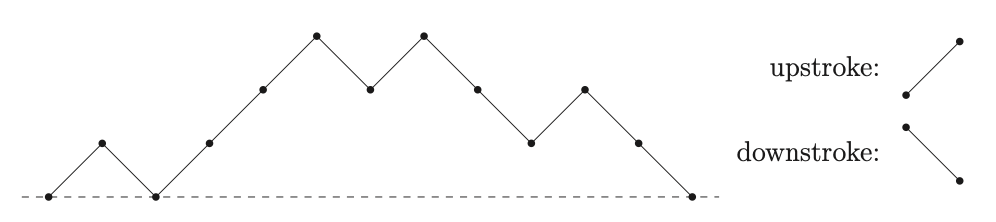
This consists of upstrokes which go upwards from left to right, and downstrokes which go downwards from left to right. The example shown has six upstrokes and six downstrokes. The horizontal line at the bottom is known as sea level.
A mountain profile of order consists of upstrokes and downstrokes, with the condition that the profile begins and ends at sea level and never goes below sea level (although it might reach sea level at any point). So the example shown is a mountain profile of order 6.
Mountain profiles can be coded by using U to indicate an upstroke and D to indicate a downstroke. The example shown has the code UDUUUDUDDUDD. A sequence of U's and D's obtained from a mountain profile in this way is known as a valid code.
Which of the following statements is/are true?
I If a valid code is written in reverse order, the result is always a valid code.
II If each U in a valid code is replaced by D and each D by U, the result is always a valid code.
III If U is added at the beginning of a valid code and D is added at the end of the code, the result is always a valid code.
This consists of upstrokes which go upwards from left to right, and downstrokes which go downwards from left to right. The example shown has six upstrokes and six downstrokes. The horizontal line at the bottom is known as sea level.
A mountain profile of order consists of upstrokes and downstrokes, with the condition that the profile begins and ends at sea level and never goes below sea level (although it might reach sea level at any point). So the example shown is a mountain profile of order 6.
Mountain profiles can be coded by using U to indicate an upstroke and D to indicate a downstroke. The example shown has the code UDUUUDUDDUDD. A sequence of U's and D's obtained from a mountain profile in this way is known as a valid code.
Which of the following statements is/are true?
I If a valid code is written in reverse order, the result is always a valid code.
II If each U in a valid code is replaced by D and each D by U, the result is always a valid code.
III If U is added at the beginning of a valid code and D is added at the end of the code, the result is always a valid code.
- A.none of them
- B.I only
- C.II only
- D.III only
- E.I and II only
- F.I and III only
- G.II and III only
- H.I, II and III
Answer: D
Question 9
1 markConsider the following attempt to solve the equation :
(I)
(II)
(III)
(IV)
(V)
The solutions of the original equation are and .
Which one of the following is true?
(I)
(II)
(III)
(IV)
(V)
The solutions of the original equation are and .
Which one of the following is true?
- A.The solution is correct.
- B.Only one of and is correct and the error arises as a result of step (II).
- C.Only one of and is correct and the error arises as a result of step (III).
- D.Only one of and is correct and the error arises as a result of step (IV).
- E.There is another value of that satisfies the original equation and the error arises as a result of step (II).
- F.There is another value of that satisfies the original equation and the error arises as a result of step (III).
- G.There is another value of that satisfies the original equation and the error arises as a result of step (IV).
Answer: F
Question 10
1 markThe function is defined for all real numbers.
Consider the following three conditions, where is a real constant:
I for all real .
II for all real .
III for all real .
Which of these conditions is/are necessary and sufficient for the graph of to have reflection symmetry in the line ?
Consider the following three conditions, where is a real constant:
I for all real .
II for all real .
III for all real .
Which of these conditions is/are necessary and sufficient for the graph of to have reflection symmetry in the line ?
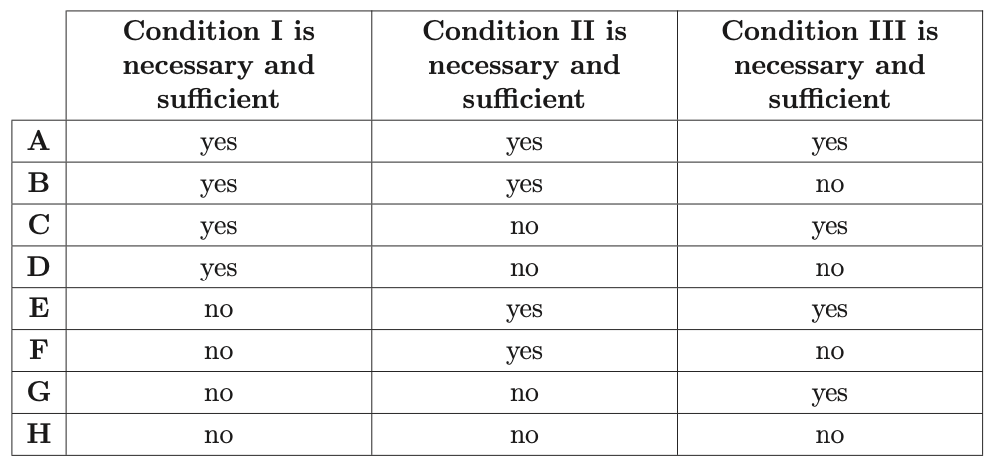
- A.Condition I: yes, Condition II: yes, Condition III: yes
- B.Condition I: yes, Condition II: yes, Condition III: no
- C.Condition I: yes, Condition II: no, Condition III: yes
- D.Condition I: yes, Condition II: no, Condition III: no
- E.Condition I: no, Condition II: yes, Condition III: yes
- F.Condition I: no, Condition II: yes, Condition III: no
- G.Condition I: no, Condition II: no, Condition III: yes
- H.Condition I: no, Condition II: no, Condition III: no
Answer: B
Question 11
1 markConsider the equation , where and are real constants.
Which of the following statements is/are true?
I The equation has a negative real solution only if .
II The equation has two distinct real solutions if .
III The equation has two distinct positive real solutions if and only if .
Which of the following statements is/are true?
I The equation has a negative real solution only if .
II The equation has two distinct real solutions if .
III The equation has two distinct positive real solutions if and only if .
- A.none of them
- B.I only
- C.II only
- D.III only
- E.I and II only
- F.I and III only
- G.II and III only
- H.I, II and III
Answer: A
Question 12
1 markConsider the following statement:
For any positive integer there is a positive integer such that is not prime for any positive integer .
Which one of the following is the negation of this statement?
For any positive integer there is a positive integer such that is not prime for any positive integer .
Which one of the following is the negation of this statement?
- A.For any positive integer there is a positive integer such that there is a positive integer for which is prime.
- B.For any positive integer there is a positive integer such that there is a positive integer for which is not prime.
- C.For any positive integer there is a positive integer such that for any positive integer , is not prime.
- D.For any positive integer , any positive integer and any positive integer , is not prime.
- E.There is a positive integer such that for any positive integer there is a positive integer for which is not prime.
- F.There is a positive integer such that for any positive integer there is a positive integer for which is prime.
- G.There is a positive integer such that for any positive integer and any positive integer , is prime.
- H.There is a positive integer and a positive integer for which there is no positive integer for which is prime.
Answer: F
Question 13
1 markThe following is an attempted proof of the conjecture:
Suppose , so in particular .
Since , then . (I)
It follows that . (II)
Therefore , (III)
which factorises to give . (IV)
Therefore . (V)
Suppose , so in particular .
Since , then . (I)
It follows that . (II)
Therefore , (III)
which factorises to give . (IV)
Therefore . (V)
- A.The proof is correct.
- B.The proof is incorrect, and the first error occurs in line (I).
- C.The proof is incorrect, and the first error occurs in line (II).
- D.The proof is incorrect, and the first error occurs in line (III).
- E.The proof is incorrect, and the first error occurs in line (IV).
- F.The proof is incorrect, and the first error occurs in line (V).
Answer: F
Question 14
1 markIn the triangle , , and .
What is the set of all the values of for which this information uniquely determines the length of ?
What is the set of all the values of for which this information uniquely determines the length of ?
- A.
- B.
- C.
- D.
- E. or
- F. or
- G.
- H.
Answer: E
Question 15
1 markIt is given that , where is a real constant.
The equation has 3 distinct real roots.
Which of the following statements is/are necessarily true?
I The equation has 3 distinct real roots.
II The equation has 3 distinct real roots.
III The equation has 3 distinct real roots.
The equation has 3 distinct real roots.
Which of the following statements is/are necessarily true?
I The equation has 3 distinct real roots.
II The equation has 3 distinct real roots.
III The equation has 3 distinct real roots.
- A.none of them
- B.I only
- C.II only
- D.III only
- E.I and II only
- F.I and III only
- G.II and III only
- H.I, II and III
Answer: G
Question 16
1 markIn this question, is an arithmetic progression, all of whose terms are integers.
Let be a positive integer. If the median of the first terms of the sequence is an integer, which of the following three statements must be true?
I The median of the first terms is an integer.
II The median of the first terms is an integer.
III The median of is an integer.
Let be a positive integer. If the median of the first terms of the sequence is an integer, which of the following three statements must be true?
I The median of the first terms is an integer.
II The median of the first terms is an integer.
III The median of is an integer.
- A.none of them
- B.I only
- C.II only
- D.III only
- E.I and II only
- F.I and III only
- G.II and III only
- H.I, II and III
Answer: F
Question 17
1 markA positive integer is called a squaresum if and only if it can be written as the sum of the squares of two integers. For example, 61 and 9 are both squaresums since and .
A prime number is called awkward if and only if it has a remainder of 3 when divided by 4. For example, 23 is awkward since .
A (true) theorem due to Fermat states that:
A positive integer is a squaresum if and only if each of its awkward prime factors occurs to an even power in its prime factorisation.
It follows that is a squaresum, since 23 occurs to the power 2, but is not, since 23 occurs to the power 3.
Which one of the following statements is not true?
A prime number is called awkward if and only if it has a remainder of 3 when divided by 4. For example, 23 is awkward since .
A (true) theorem due to Fermat states that:
A positive integer is a squaresum if and only if each of its awkward prime factors occurs to an even power in its prime factorisation.
It follows that is a squaresum, since 23 occurs to the power 2, but is not, since 23 occurs to the power 3.
Which one of the following statements is not true?
- A.Every square number is a squaresum.
- B.If and are squaresums, then so is .
- C.If is a squaresum, then and are squaresums.
- D.If is not a squaresum, then is a squaresum for some number which is a product of awkward primes.
Answer: C
Question 18
1 mark is a polynomial function defined for all real .
Which of the following is a necessary condition for the inequality
to be true for all real numbers and with ?
Which of the following is a necessary condition for the inequality
to be true for all real numbers and with ?
- A. for all real
- B. for all real
- C. for all real
- D. for all real
- E. for all real
- F. for all real
Answer: C
Question 19
1 markThree real numbers and satisfy .
Which one of the following statements must be true?
Which one of the following statements must be true?
- A.
- B.
- C.
- D.
Answer: C
Question 20
1 markIt is given that the equation has at least one real solution for , where is a real constant.
What is the complete set of possible values for ?
What is the complete set of possible values for ?
- A. or
- B. or
- C.
- D.
- E.
- F.
Answer: B