TMUA 2020 D513/01
20 questions20 marks75Updated September 2025
The TMUA 2020 D513/01 paper in full: all 20 questions, each with its answer. TMUA is the Test of Mathematics for University Admission. Sit it cold under exam timing, mark it, then work back through anything you missed using the solutions below.
Download the original PDF →Questions and answers are free. Full step-by-step worked solutions unlock with a free account. Start practising.
Question 1
1 markWhich of the following is an expression for the first derivative with respect to of
- A.
- B.
- C.
- D.
- E.
- F.
Answer: C
Question 2
1 mark and are factors of . What is the value of ?
- A.-10
- B.
- C.
- D.
- E.
- F.10
Answer: C
Question 3
1 markFind the complete set of values of for which and $(x + 2)(x - 2) < 0
- A.
- B.
- C.
- D. or
- E. or
- F. or
- G. or
Answer: B
Question 4
1 markThe , and terms of a geometric progression are also the , and terms, respectively, of an arithmetic progression.
The sum to infinity of the geometric progression is 12.
Find the term of the geometric progression.
The sum to infinity of the geometric progression is 12.
Find the term of the geometric progression.
- A.1
- B.2
- C.3
- D.4
- E.5
- F.6
Answer: D
Question 5
1 markThe curve has equation where and are constants.
has a line of symmetry at and touches the -axis at exactly one point.
What is the value of ?
has a line of symmetry at and touches the -axis at exactly one point.
What is the value of ?
- A.6
- B.18
- C.21
- D.25
- E.38
Answer: A
Question 6
1 markFind the maximum value of the function
- A.
- B.
- C.
- D.3
- E.4
- F.7
Answer: C
Question 7
1 markGiven that and what is the value of ?
- A.-23
- B.-22
- C.-15
- D.-14
- E.-11
- F.-10
Answer: A
Question 8
1 markThe function is defined for all real as .
Find the complete set of values of for which the maximum value of is less than 4.
Find the complete set of values of for which the maximum value of is less than 4.
- A.
- B.
- C.
- D.
- E.
- F.
Answer: D
Question 9
1 markThe quadratic expression factorises as , where and are positive real numbers.
Which quadratic expression can be factorised as ?
Which quadratic expression can be factorised as ?
- A.
- B.
- C.
- D.
- E.
- F.
Answer: C
Question 10
1 markThe following sequence of transformations is applied to the curve
1. Translation by
2. Reflection in the -axis
3. Stretch parallel to the -axis with scale factor 2
What is the equation of the resulting curve?
1. Translation by
2. Reflection in the -axis
3. Stretch parallel to the -axis with scale factor 2
What is the equation of the resulting curve?
- A.
- B.
- C.
- D.
- E.
- F.
- G.
- H.
Answer: A
Question 11
1 markThe quadratic function shown passes through and , where .
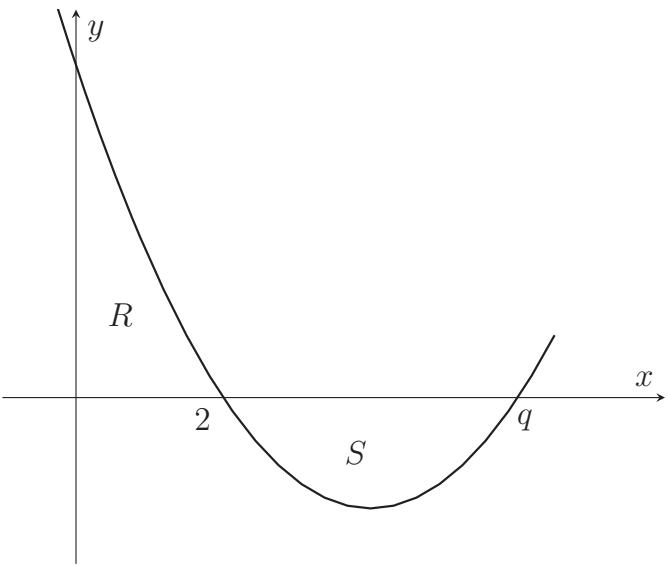
What is the value of such that the area of region equals the area of region ?
What is the value of such that the area of region equals the area of region ?
- A.
- B.3
- C.
- D.4
- E.6
- F.
Answer: E
Question 12
1 markHow many real solutions are there to the equation where is in radians?
- A.0
- B.1
- C.2
- D.3
- E.4
- F.5
- G.infinitely many
Answer: D
Question 13
1 markFind the coefficient of in the expansion of
- A.6
- B.10
- C.21
- D.35
- E.105
- F.210
Answer: F
Question 14
1 markThe area enclosed between the line and the curve is 6.
What is the value of ?
What is the value of ?
- A.2
- B.4
- C.
- D.
- E.
- F.
Answer: E
Question 15
1 markFind the positive difference between the two real values of for which
- A.4
- B.16
- C.
- D.
- E.
- F.
Answer: C
Question 16
1 markThe circle has equation
The circle has equation
The straight line is a tangent to both and and has positive gradient.
The acute angle between and the -axis is
Find the value of
The circle has equation
The straight line is a tangent to both and and has positive gradient.
The acute angle between and the -axis is
Find the value of
- A.
- B.2
- C.
- D.
- E.
- F.
- G.
- H.
Answer: C
Question 17
1 markFind the complete set of values of in terms of such that the graphs of and have two points of intersection.
- A.
- B.
- C.
- D.
- E.
- F.
Answer: A
Question 18
1 markFind the number of solutions and the sum of the solutions of the equation where
- A.Number of solutions = 2
Sum of solutions = - B.Number of solutions = 2
Sum of solutions = - C.Number of solutions = 3
Sum of solutions = - D.Number of solutions = 3
Sum of solutions = - E.Number of solutions = 4
Sum of solutions = - F.Number of solutions = 4
Sum of solutions =
Answer: A
Question 19
1 markFind the lowest positive integer for which is positive.
- A.26
- B.27
- C.51
- D.52
- E.53
- F.54
Answer: E
Question 20
1 markFor how many values of is the equation satisfied by exactly two distinct values of ?
- A.0
- B.1
- C.2
- D.3
- E.4
- F.more than 4
Answer: C