Factorising Quadratic Expressions for the TMUA
Updated August 2025
This lesson teaches how to factorise quadratic expressions into two linear brackets. It covers monic and non-monic quadratics as well as the difference of two squares. Mastering these techniques is vital for the TMUA as they allow for solving equations and simplifying complex algebraic fractions quickly.
Factorising is the inverse process of expanding brackets. A quadratic expression is factorised by finding two linear binomials whose product recovers the original expression, typically in the form .
Factorising Monic Quadratics of the form
A monic quadratic is one where the coefficient of is 1. Many such expressions can be written as a product of two linear factors with integer coefficients: . To find the values of and , we look for two numbers that satisfy two conditions: their sum must be and their product must be .
Worked Example:
To factorise , we need two numbers and such that and . By checking factor pairs of 72, we find that 8 and 9 work because and . Therefore, .
Worked Example:
For , we need a product of and a sum of . The numbers and satisfy this. Thus, .
The Difference of Two Squares
Expressions in the form are known as the difference of two squares. They always factorise into the pattern . This occurs because the middle term cancels out during expansion ().
Worked Example:
Since , we use the identity . Alternatively, we can view this as , seeking a product of and a sum of 0, which leads to and .
Worked Example:
This identity can even be applied when the constant is not a perfect square integer. Since , we can write .
Factorising Non Monic Quadratics of the form
When the coefficient of is not 1, the process is more involved. We seek to find such that , , and .
Method 1: The Table Method
We can systematically test pairs of factors for and . For , we identify .
Factors for (): (6, 1), (1, 6), (2, 3), (3, 2). Factors for (): (1, 20), (20, 1), (2, 10), (10, 2), (4, 5), (5, 4).
By testing , we find that the combination gives . The correct factorisation is .
Method 2: Splitting the Middle Term
Alternatively, we find two numbers that multiply to give (the product of the coefficient and the constant) and add to give .
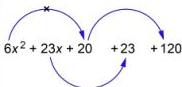
For , we need a product of and a sum of 23. These numbers are and . We then split the term: . Factorise the first two terms and the last two terms separately: . Since is now a common factor, we have .
Worked Example:
We need two numbers that multiply to and add to . These are and .
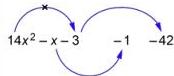
.
Difference of Two Squares with Coefficients
Quadratic expressions of the form also follow the difference of two squares identity, factorising as .
Worked Example:
Both terms are perfect squares: and . Therefore, .
Key takeaways
- To factorise , find two numbers with product and sum .
- The Difference of Two Squares always factorises as .
- For non-monic quadratics (), use the method to split the middle term and factorise by grouping.
- Always check your result by expanding the brackets to see if you recover the original expression.
In the TMUA, speed is key. Practise recognising factor pairs for common products like 36, 48, 72, and 120. Also, always look for a common numerical factor first (e.g., ) to simplify the expression before factorising the quadratic part.
A common mistake in the difference of two squares is forgetting that it only applies to subtraction. An expression like cannot be factorised into real linear factors.
The ability to factorise a quadratic is directly linked to finding its roots. If a quadratic factorises as , then and are the x-intercepts (roots) of the corresponding parabola .
Worked Examples
Practice Questions
Frequently asked questions
What if a quadratic expression cannot be factorised with integers?
Not all quadratics have integer factors. If you cannot find two integers that meet the product and sum requirements, the quadratic may not factorise neatly. In such cases, you might use the quadratic formula or complete the square to find roots, which may involve surds.
Does the order of the brackets matter?
No. Because multiplication is commutative, is exactly the same as .
How do I handle negative signs in the splitting the middle term method?
Be very careful when factorising a negative out of the second pair of terms. For example, in , the applies to both terms in the original split, so the signs inside the bracket must be consistent to allow for the grouping step.