Working with Coordinates in All Four Quadrants
Updated August 2025
Coordinate geometry uses two perpendicular axes to locate points precisely in a two-dimensional plane. For the TMUA, you must be confident navigating all four quadrants, understanding how the signs of and coordinates change. This fundamental skill is essential for solving geometric problems involving shapes and distances.
A point in a plane is defined by an ordered pair , representing its displacement from a central origin along horizontal and vertical axes that divide the space into four quadrants.
The Coordinate Axes
The coordinate axes, and , provide a systematic way of locating any point within a flat plane. These two lines intersect at a central point called the origin. The intersection of these axes divides the entire plane into four distinct regions known as quadrants.
In standard representation, the axis is the horizontal line. Numbers to the right of the origin are positive, while numbers to the left of the origin are negative. The axis is the vertical line. Numbers above the origin are positive, and numbers below the origin are negative.
Identifying Points in Four Quadrants
The position of any point is expressed as two numbers enclosed in brackets, separated by a comma. This is written as , where the coordinate always precedes the coordinate.
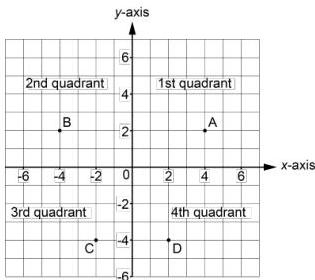
In the diagram above, the four quadrants are illustrated with specific points:
- Point A is , located in the first quadrant where both and are positive.
- Point B is , located in the second quadrant where is negative and is positive.
- Point C is , located in the third quadrant where both and are negative.
- Point D is , located in the fourth quadrant where is positive and is negative.
Solving Geometric Problems with Coordinates
Coordinates allow for the construction and analysis of geometric shapes. By knowing the properties of a shape, such as a square, you can deduce missing coordinates by calculating lengths along the axes.
Worked Example: Finding Coordinates of a Square
A square is drawn on a coordinate grid. You are given that is the point and is the point . It is also known that vertex lies in the fourth quadrant and vertex lies in the third quadrant. What are the coordinates of and ?
Step 1: Calculate the side length. Point is 6 units to the left of the axis and 4 units above the axis. Point is 3 units to the right of the axis and 4 units above the axis. Since both and have the same coordinate, the line segment is horizontal. The distance between them is units. Therefore, the side length of the square is 9 units.
Step 2: Locate vertex . Since is in the fourth quadrant and forms a square with , it must be 9 units directly below point . Its coordinate remains 3, but its coordinate becomes . Thus, is at .
Step 3: Locate vertex . Similarly, is in the third quadrant and must be 9 units directly below point . Its coordinate remains , and its coordinate becomes . Thus, is at .
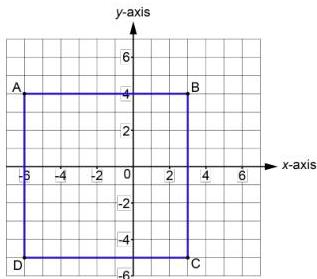
The final coordinates are and , as shown in the diagram above.
Key takeaways
- The origin is the point where the and axes intersect.
- Coordinates are always written as , with the horizontal position first and the vertical position second.
- The four quadrants are ordered anticlockwise, starting from the top right .
- Horizontal lines have the same coordinate, while vertical lines have the same coordinate.
- To find the distance between two points on a horizontal or vertical line, calculate the difference between their changing coordinates.
When solving coordinate geometry problems in the TMUA, always perform a quick sketch of the axes. Visualising the quadrants prevents simple sign errors, especially when moving 'down' or 'left' into negative territory.
A common mistake is reversing the order of the coordinates. Always remember that the axis comes first. One way to remember this is 'along the corridor and then up the stairs'.
The Cartesian coordinate system is the foundation of analytical geometry. It allows us to represent algebraic equations as geometric curves, which is a powerful tool for solving complex mathematical problems by visualising them spatially.
Worked Examples
Practice Questions
Frequently asked questions
How do I know which quadrant a point like is in?
Since both the and coordinates are negative, the point is in the third quadrant. This is to the left of the axis and below the axis.
What happens if a coordinate is zero, such as or ?
If a coordinate is zero, the point lies directly on one of the axes. Point is on the axis, and point is on the axis. These points are not considered to be inside any specific quadrant.
In the square example, how did we know to subtract 9 from the coordinate?
The problem states that and are in the fourth and third quadrants respectively. Since and are above the axis (positive ), and and are below the axis (negative ), we must move downwards from and , which requires subtraction from the values.