Geometry for the TMUA
Updated August 2025
Geometry involves applying angle facts and shape properties to solve problems involving lines, triangles, and quadrilaterals. For the TMUA, you must master triangle congruence criteria, similarity ratios, and circle theorems. Understanding these logical foundations is essential for efficient angle chasing and calculating side lengths in complex geometric configurations.
Geometric reasoning is based on the application of invariant properties such as angle sums, congruence criteria (, , , , ), and similarity () to establish relationships between sides and angles.
Basic Angle Results and Parallel Lines
To solve geometry problems effectively, you must be fluent in the fundamental results concerning angles and lines. These facts form the basis for 'angle chasing' in more complex diagrams.
- Angles on a line: The sum of angles on a straight line is .
- Angles at a point: The sum of angles meeting at a single point is .
- Vertically opposite angles: When two straight lines intersect, the angles opposite each other are equal.
- Parallel lines: When a transversal line crosses two parallel lines, three specific relationships arise:
- Alternate angles are equal (the Z shape).
- Corresponding angles are equal (the F shape).
- Co-interior angles (allied angles) sum to (the C shape).
Triangle Congruence and Similarity
Triangles are the building blocks of most geometric proofs. You must distinguish between congruence, where triangles are identical in shape and size, and similarity, where triangles are the same shape but different sizes.
Triangle Notation
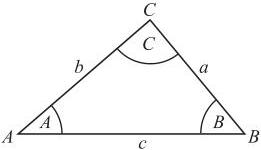
By convention, we label the vertices of a triangle with capital letters and the sides opposite those vertices with the corresponding lower-case letters. Side is opposite vertex , side is opposite vertex , and side is opposite vertex .
Criteria for Congruence
Two triangles are congruent if they satisfy any one of the following conditions:
- SSS (Side-Side-Side): All three corresponding sides are equal.
- SAS (Side-Angle-Side): Two sides and the included angle (the angle between them) are equal.
- ASA or AAS (Angle-Side-Angle): Two angles and a corresponding side are equal. Since the sum of angles is , knowing two angles automatically gives the third.
- RHS (Right-angle-Hypotenuse-Side): In right-angled triangles, the hypotenuse and one other side are equal.
Criteria for Similarity
Triangles are similar if their corresponding angles are equal (AAA). If two triangles are similar, the ratios of their corresponding sides are constant. If the ratio of corresponding side lengths is , then the ratio of their areas is .
The Ambiguous Case (ASS)
When given two sides and a non-included angle, a triangle is not necessarily uniquely defined. This is known as the ambiguous case. Consider a triangle where angle , side , and side .
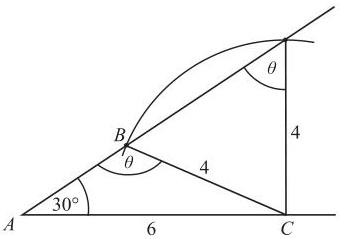
Applying the sine rule:
This gives two possible values for : or . Since , both angles are possible, resulting in two distinct triangles that satisfy the given information.
Properties of Quadrilaterals
You are expected to know the properties of sides, angles, and diagonals for the following quadrilaterals:
- Parallelogram: Opposite sides and angles are equal. Diagonals bisect each other.
- Rhombus: A parallelogram with four equal sides. Diagonals bisect each other at .
- Rectangle: A parallelogram with four right angles. Diagonals are equal in length and bisect each other.
- Square: A regular quadrilateral (both a rhombus and a rectangle).
- Trapezium: Has at least one pair of parallel sides.
- Kite: Two pairs of adjacent sides are equal. One pair of opposite angles is equal. Diagonals intersect at .
Circle Geometry and Theorems
Many geometry questions on the TMUA require the application of circle theorems. The following properties are essential:
- Chords: The perpendicular from the centre of a circle to a chord bisects that chord.
- Tangents: The tangent at any point on a circle is perpendicular to the radius at that point.
- Angles at the Centre: The angle subtended by an arc at the centre is twice the angle subtended at any point on the circumference.
- Semicircles: The angle subtended in a semicircle is a right angle ().
- Segments: Angles in the same segment (subtended by the same arc) are equal.
- Cyclic Quadrilaterals: The opposite angles in a cyclic quadrilateral sum to .
- Alternate Segment Theorem: The angle between a tangent and a chord at the point of contact is equal to the angle in the alternate segment.
Key takeaways
- Congruence requires specific sets of evidence: , , , , or . proves similarity but not congruence.
- If side lengths of similar shapes are in the ratio , their areas are in the ratio .
- Parallel line rules (, , ) are the most common tools for angle chasing in polygon problems.
- The sum of interior angles of an -sided polygon is , while the exterior angles always sum to .
When 'angle chasing' in a circle, always look for radii to identify hidden isosceles triangles. These triangles provide equal angles that are often the missing link in a geometry proof.
Be careful with the congruence rule. The angle must be the 'included angle' (the one formed by the two known sides). If the angle is not between the sides, the triangles may not be congruent.
Similarity is the geometric equivalent of 'scaling'. Many TMUA problems that look like they require the sine rule can be solved more quickly by identifying similar triangles and using side-length ratios.
Worked Examples
Practice Questions
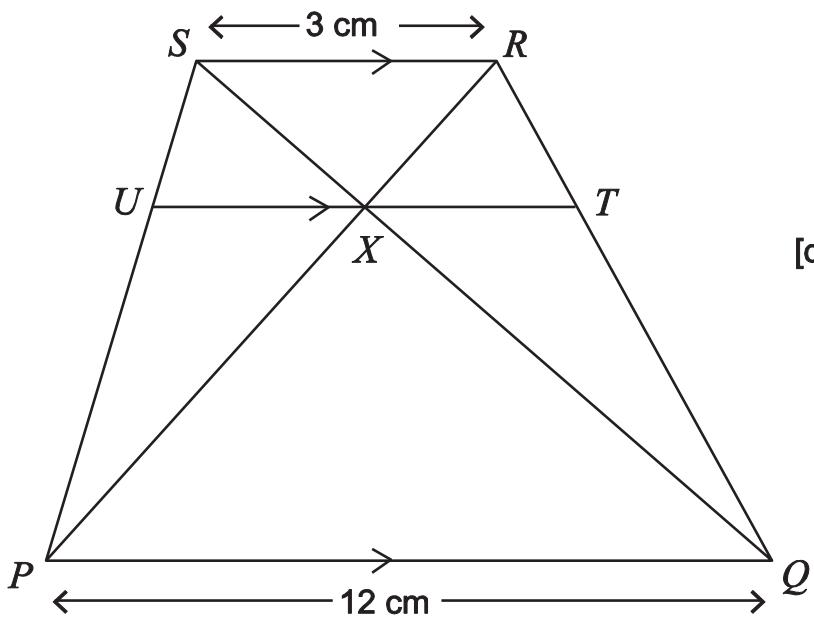
The diagonals of the trapezium meet at .
lies on and lies on such that is a line segment through parallel to .
The length of is 12 cm and the length of is 3 cm.
What, in centimetres, is the length of ?
Frequently asked questions
Is Side-Side-Angle (SSA) a valid congruence criterion?
No. is not a general congruence criterion because it can lead to the 'ambiguous case' where two different triangles can be formed, as shown in the example with .
What is the difference between a rhombus and a parallelogram?
Every rhombus is a parallelogram, but a rhombus specifically has four equal sides and diagonals that intersect at right angles.
How do you find the exterior angle of a regular polygon?
For a regular polygon with sides, each exterior angle is because the sum of exterior angles is always .
What defines a cyclic quadrilateral?
A cyclic quadrilateral is a four-sided shape where all four vertices lie on the circumference of a circle. Its key property is that opposite angles sum to .