Geometry Angle Properties and Polygons for the TMUA
Updated August 2025
Master the fundamental principles of Euclidean geometry required for the TMUA. This guide covers angle relationships on lines, parallel lines, and the geometric properties of triangles and quadrilaterals. You will also learn to calculate the interior and exterior angle sums of any polygon.
Angles on a line sum to , while interior angles of an -sided polygon sum to and exterior angles always sum to .
Understanding the properties of angles and shapes is essential for solving the geometric reasoning problems frequently encountered in the TMUA. These rules form the logical basis for more complex proofs and calculations.
Angles at a Point and on a Straight Line
The most basic geometric properties involve angles in relation to points and lines. Angles formed on a straight line always sum to . When multiple angles meet at a single point to form a full rotation, the sum of those angles is . These rules are often used to find unknown angles in diagrams before applying more advanced theorems.
Intersecting and Perpendicular Lines
When two straight lines intersect, they form four angles. The angles that are non-adjacent and directly opposite each other at the vertex are called vertically opposite angles. These angles are always equal. Perpendicular lines are a special case where the lines intersect at an angle of exactly .
Angle Properties of Parallel Lines
Parallel lines are lines in the same plane that never meet, no matter how far they are extended. When a transversal line crosses two or more parallel lines, specific angle relationships are created:
- Corresponding angles are equal. They are in the same relative position at each intersection where the transversal crosses the parallel lines.
- Alternate angles are equal. They are on opposite sides of the transversal and between the parallel lines.
- Co-interior angles (also known as allied angles) sum to . These are on the same side of the transversal and between the parallel lines.
Angles in Triangles and Quadrilaterals
Triangles and quadrilaterals have fixed interior angle sums that are used extensively in geometric problems:
- Triangles: The interior angles of any triangle sum to . In an isosceles triangle, two angles are equal, while in an equilateral triangle, all three angles are . The exterior angle of a triangle is always equal to the sum of the two opposite interior angles.
- Quadrilaterals: The interior angles of any quadrilateral sum to . Parallelograms and rhombuses have equal opposite angles, and their adjacent angles are co-interior, summing to .
Interior and Exterior Angles of Polygons
A polygon is a closed plane figure with straight sides. The properties of its angles depend on the number of sides:
- Sum of Interior Angles: The sum of the interior angles of a polygon with sides is given by the formula . This is because any polygon can be divided into triangles by drawing diagonals from a single vertex.
- Sum of Exterior Angles: For any convex polygon, the sum of the exterior angles is always , regardless of the number of sides.
- Regular Polygons: In a regular polygon, all sides and interior angles are equal. The size of each exterior angle is , and each interior angle can be found by calculating .
At any vertex of a polygon, the interior angle and its corresponding exterior angle lie on a straight line and therefore must sum to .
Key takeaways
- Angles on a straight line sum to and angles at a point sum to .
- Parallel lines create equal alternate and corresponding angles, and co-interior angles summing to .
- The sum of interior angles of an -sided polygon is .
- The sum of exterior angles for any convex polygon is always .
When solving complex diagrams in the TMUA, always look for hidden parallel lines or triangles. Use the exterior angle theorem for triangles to save time, as it is often faster than calculating the third interior angle first.
Be careful with the term 'interior angle sum'. Students often confuse it with the sum of exterior angles. Always check if the question asks for a single angle in a regular polygon or the sum for the whole shape.
The formula works because every -gon can be triangulated into triangles. This connection between simple triangles and complex polygons is a great example of how mathematicians break down complex structures into familiar components.
Worked Examples
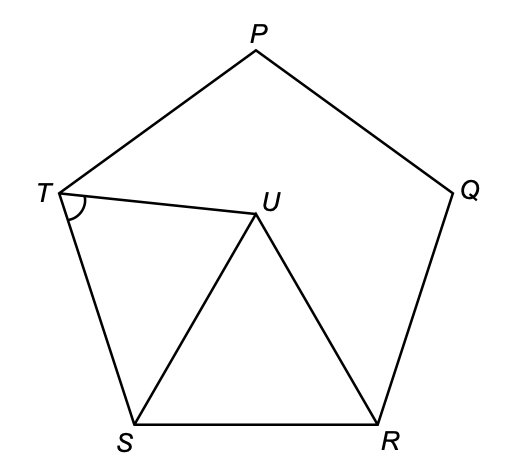
[diagram not to scale]
PQRST is a regular pentagon.
RSU is an equilateral triangle.
What is the size of angle STU?
Practice Questions
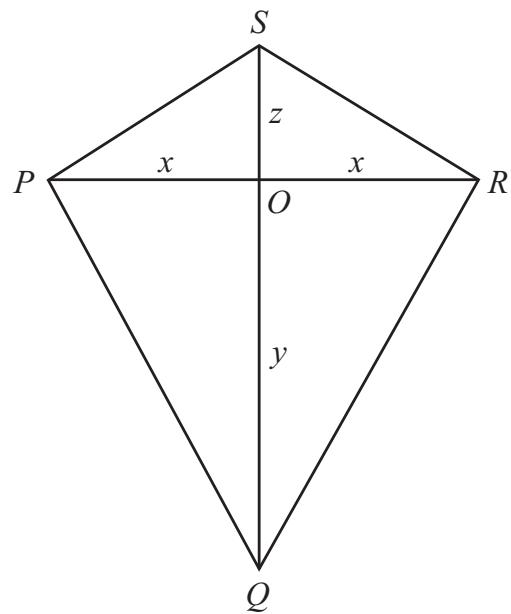
Which of the following is necessary and sufficient for angle to be a right angle?
Frequently asked questions
What is the difference between an interior and an exterior angle?
An interior angle is the angle inside the polygon at a vertex. An exterior angle is formed by extending one side of the polygon. The sum of an interior angle and its adjacent exterior angle is always because they lie on a straight line.
How do I find the number of sides of a regular polygon if I know the interior angle?
First, find the exterior angle by subtracting the interior angle from . Then, divide by the exterior angle to find , the number of sides.
Does the sum of exterior angles change if the polygon is not regular?
No. The sum of the exterior angles of any convex polygon is always , whether the polygon is regular or irregular.