Manipulating Surds for the TMUA
Updated August 2025
Surds are numerical expressions containing roots that cannot be simplified to rational numbers. They are essential in the TMUA for providing exact answers without decimal rounding. This topic covers simplifying square roots, multiplying surdic brackets, and rationalising denominators to ensure algebraic precision in university admissions mathematics.
A surd is an irrational number expressed using a root symbol, typically . Manipulation involves simplifying these roots, expanding algebraic expressions containing them, and removing them from denominators using identities like the difference of two squares.
What is a Surd?
A surd is an expression containing a root, usually a square root, that cannot be simplified into a rational number. For example, is a surd because is irrational and the expression cannot be reduced to a fraction. Conversely, is not a surd because it simplifies to , which is a rational integer.
Surds allow mathematicians to express numbers exactly. Because the decimal expansion of an irrational number like is non-terminating and non-recurring, writing it as a decimal involves a loss of precision. In the TMUA, we follow the standard convention that the square root symbol refers specifically to the positive square root. Therefore, is , not . If both roots are required, we write .
Simplifying Square Roots
You are expected to simplify square roots by identifying square factors within the radicand. For instance:
- .
- .
Multiplying Surd Expressions
When multiplying expressions containing surds, treat the square roots as you would an algebraic variable like , then simplify the numerical terms at the final stage. Consider the expansion of :
This follows the same pattern as , substituting and noting that .
Factorising Expressions with Surds
While expanding is straightforward, reversing the process to find the square root of requires a systematic approach. To factorise into the form , we expand the general form:
By matching the terms, we see that (so ) and . By testing integer pairs for such as , and , we find that and satisfies the second equation since . Thus, .
Note on Negative Signs: When factorising , you might find . However, because the square root symbol must represent a positive value, and , the correct answer is the absolute value: .
Rationalising the Denominator
Rationalising the denominator involves transforming a fraction so that the denominator contains no surds. In simple cases like , we multiply by to get .
For more complex denominators, we use the difference of two squares identity: . By multiplying the numerator and denominator by the conjugate of the denominator, we eliminate the root.
Worked Example 1: Rationalise .
Multiply by the conjugate :
.
Worked Example 2: Rationalise .
Multiply by the conjugate :
.
Advanced Rationalisation with Cubic Identities
You can extend these principles to cube roots using the identities and . For example, to rationalise , we let and . The denominator is . Multiplying by gives . Thus:
.
Key takeaways
- A surd like always represents the positive square root in the TMUA.
- Simplify surds by extracting the largest square factor from the radicand.
- Rationalise denominators by multiplying the numerator and denominator by the conjugate of the denominator.
- Use the difference of two squares identity to remove roots from denominators.
- When factorising square roots of surdic expressions, ensure the result is positive by checking the magnitude of terms.
When rationalising, if you have a choice, pick a conjugate that results in a positive denominator to avoid mistakes with negative signs in the final simplification. For example, if the denominator is , multiplying by gives a denominator of , which is cleaner than .
Be careful when squaring terms like . A common error is to only square the root or only square the coefficient. Remember that . Always keep brackets around the term being squared.
Rationalising the denominator is more than just a simplification rule. It is a process of finding a multiplicative inverse in a field extension. In higher mathematics, this relates to the fact that for any algebraic number in a field, its inverse can also be expressed in terms of the same radical basis.
Worked Examples
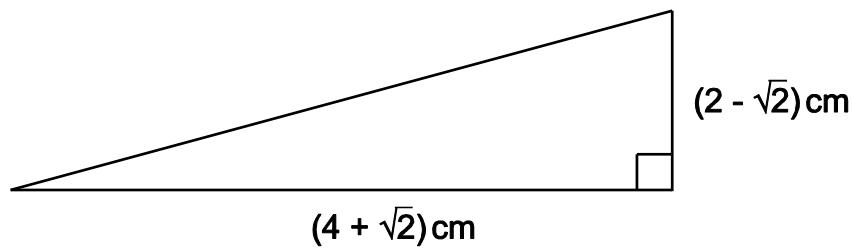
[diagram not to scale]
Calculate the area of the triangle.
Practice Questions
Frequently asked questions
Why is the square root of a number always positive in surds?
By mathematical convention, the radical symbol refers only to the principal (positive) square root of . This ensures that functions like are well-defined and only produce one output for each input.
How do I decide which conjugate to use for rationalisation?
The conjugate is found by changing the sign between the two terms in the denominator. If the denominator is , the conjugate is . If it is , the conjugate is .
Can I rationalise a denominator with more than two terms?
Yes, but it requires multiple steps. You would group two of the terms together as a single term, use the conjugate method once to eliminate one root, and then repeat the process for the resulting expression.
What is the difference between an irrational number and a surd?
All surds are irrational numbers, but not all irrational numbers are surds. For example, and are irrational but are not surds because they are not roots of rational numbers.