Simultaneous Equations and Substitution for the TMUA
Updated July 2025
Simultaneous equations involve finding specific coordinate pairs that satisfy multiple equations at once. For the TMUA, you must be proficient in solving these analytically, particularly by using substitution to combine linear and quadratic equations. This technique is essential for finding the intersection points of geometric curves.
Solving simultaneous equations is the process of finding the intersection of sets of number pairs that satisfy two or more equations concurrently, representing the geometric points where their graphs meet.
Understanding Equations and Their Graphs
An equation like is essentially a concise way to represent an infinite set of number pairs . For example, , , and are all members of this set. Geometrically, we represent these pairs on a Cartesian plane as the line . Every point on that line corresponds to a pair in the set. Moving between the algebraic set of pairs and the geometric picture of the graph is a fundamental skill for university admission tests.
When we talk about simultaneous equations, we are looking for the number pairs that appear in both sets at the same time. Geometrically, this corresponds to the points where the graphs of the equations cross.
Solving Linear Simultaneous Equations
Consider the following two linear equations:
To solve these simultaneously, we can use three primary methods: substitution, elimination, or graphical analysis.
By Substitution
We rearrange one equation to make one variable the subject and then substitute this into the other equation. In equation (1), we can write . Substituting this into equation (2) gives:
Since , then . The solution is .
By Elimination
Alternatively, we can manipulate the equations to make the coefficients of one variable identical. Multiplying equation (1) by 2 gives . We then subtract equation (2) from this new equation:
Substituting back into yields .
Graphical Interpretation
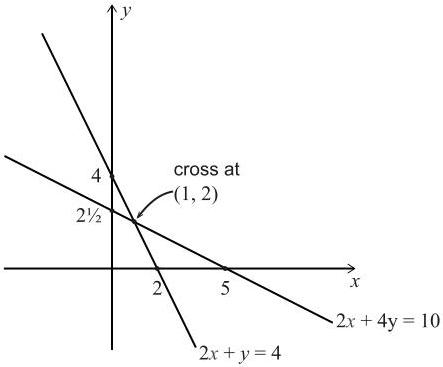
Drawing both lines on the plane reveals they intersect at a single point, .
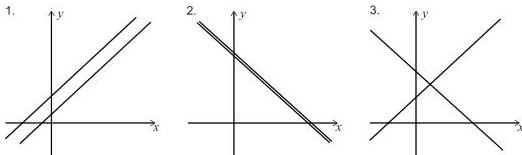
For any pair of linear equations, there are three geometric possibilities:
- Parallel and distinct lines: These have the same gradient but different intercepts. They never cross, meaning there are no solutions. For example, and .
- Parallel and identical lines: These are the same line written in different ways. Every point on the line is a solution, meaning there are infinitely many solutions. For example, and .
- Non-parallel lines: These lines have different gradients and must cross exactly once. These systems always have one unique solution.
Linear and Quadratic Simultaneous Equations
Things become more interesting when one equation is linear and the other is a quadratic. A quadratic equation generally takes the form . When solving these simultaneously with a line, we usually use substitution to eliminate one variable, resulting in a single quadratic equation in terms of or .
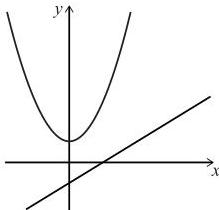
There are three geometric possibilities for the intersection of a line and a quadratic:
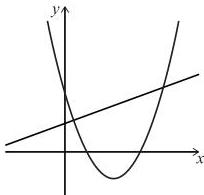
- The line crosses the quadratic: There are two distinct real solutions.
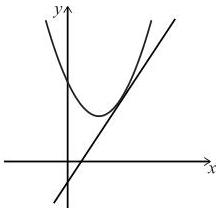
- The line is tangent to the quadratic: The line just touches the curve at one point. This results in one repeated real solution.
- The line never crosses the quadratic: There are no real solutions.
Worked Example: Linear and Quadratic
Solve and simultaneously.
To solve, we eliminate by setting the two expressions for equal to each other:
Rearranging into the standard quadratic form :
This factorises to:
This gives a single repeated solution for :
To find the coordinate, we substitute into the simpler linear equation:
Because there is only one repeated solution at , we know geometrically that the line is a tangent to the parabola .
Further Exploration
While the TMUA focuses on linear and quadratic systems, you should consider the implications for higher-order polynomials. For example, a quadratic and a cubic could have up to three intersection points. Unlike a line and a quadratic, a line and a cubic must cross at least once. This is because the ends of a cubic function go to positive infinity in one direction and negative infinity in the other, eventually forcing an intersection with any line.
Key takeaways
- Simultaneous solutions represent the geometric points where graphs intersect on the Cartesian plane.
- For linear systems, check for parallel gradients to determine if there are zero, one, or infinite solutions.
- When solving a linear and quadratic system, substitution typically leads to a new quadratic equation whose discriminant () indicates the number of intersection points.
- A repeated solution in a linear-quadratic system signifies that the line is a tangent to the curve.
Always look for the easiest variable to substitute. If one equation is , it is simpler to rearrange for () than for () to avoid working with fractions unnecessarily.
When substituting a linear expression into a quadratic, be extremely careful with signs and brackets. For example, if you are substituting into , you must expand , not just .
The relationship between algebra and geometry is powerful. If a question asks for the number of solutions rather than the solutions themselves, you can often save time by finding the discriminant of the resulting equation instead of solving it fully.
Worked Examples
Practice Questions
Frequently asked questions
Can simultaneous equations have no solutions?
Yes. Geometrically, this happens when the graphs do not intersect. For two lines, this occurs if they are parallel and have different intercepts. For a line and a quadratic, this occurs if the resulting quadratic equation has a negative discriminant, .
Why is substitution often preferred over elimination for non-linear systems?
Elimination works best when variables have the same power in both equations. In a linear-quadratic system, one equation has while the other has . Substitution allows you to replace in the quadratic with a linear expression of , reducing the system to a solvable quadratic equation in a single variable.
How do I find the coordinates if I only have the x value?
Once you have found the values of the intersection points, substitute them back into either of the original equations. It is usually easier to use the linear equation to find the corresponding values.