Coordinate Geometry of Lines and Circles
Updated August 2025
Coordinate geometry bridges algebra and geometry by representing shapes with equations on a two dimensional plane. For the TMUA, you must be proficient in manipulating the equations of straight lines and circles to find intersections, tangents, and shortest distances. Mastery of completing the square is essential for identifying circle properties.
The relationship between algebraic equations and geometric shapes in the plane, where every point on a curve satisfies its specific equation, such as for lines and for circles.
Straight Lines in the Plane
The equation of a straight line can be expressed in several forms. The most familiar is , where is the gradient and is the intercept. For the TMUA, you must also be fluent with , which describes a line with gradient passing through point , and the general form .
Understanding the Gradient
The gradient measures the steepness or the rate of change of with respect to . It tells us how much changes for every 1 unit increase in .
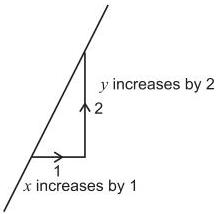
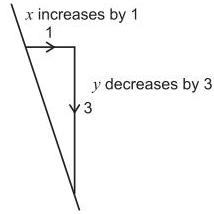
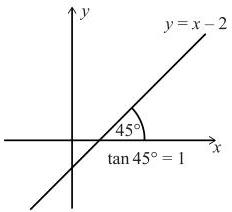
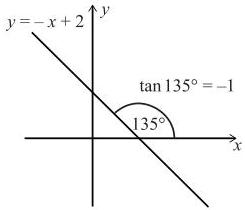
Geometrically, the gradient is the tangent of the angle that the line makes with the positive axis, assuming identical scales on both axes (). For instance, a line at has a gradient of .
Parallel and Perpendicular Lines
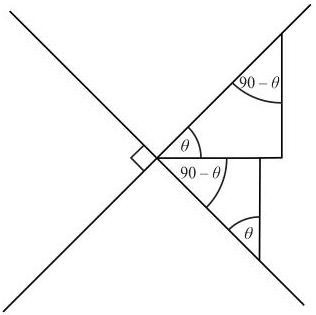
Two lines and are parallel if and only if they have the same steepness, meaning . They are perpendicular if and only if the product of their gradients is , or . This relationship excludes vertical and horizontal lines, which should be treated as special cases ( and respectively).
The Coordinate Geometry of the Circle
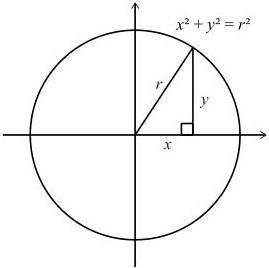
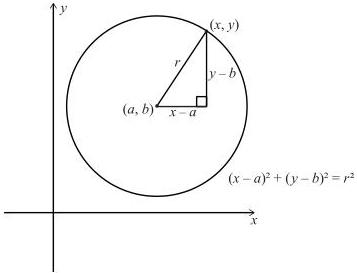
A circle is the set of all points at a fixed distance (the radius) from a central point . Using Pythagoras theorem, we can derive the standard equation of a circle.
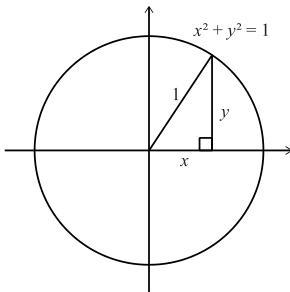
For a circle centred at the origin with radius , the equation is .
When the centre is shifted to , the equation becomes .
Converting Between Forms
Circles may also appear in the form . To find the centre and radius, you must complete the square for both and terms.
Example 1: Find the centre and radius of .
First, group the terms: . Completing the square: . Rearranging: . The centre is and the radius is .
Example 2: Not every equation of this form is a circle. Consider . Completing the square: , which gives . Since a sum of squares cannot be negative in the real number system, no points satisfy this equation. It is not a circle.
Example 3: For , first divide by 2 to get . Then complete the square to find the centre and radius .
Problems Involving Lines and Circles
Tangency and Intersections
A line can intersect a circle twice, touch it once (as a tangent), or not at all. To find these points, solve the equations simultaneously. This will lead to a quadratic equation. The discriminant determines the nature of the intersection:
- : Two distinct intersections.
- : One repeated root. The line is a tangent.
- : No real intersections.
Worked Example: Find the values of for which is tangent to .
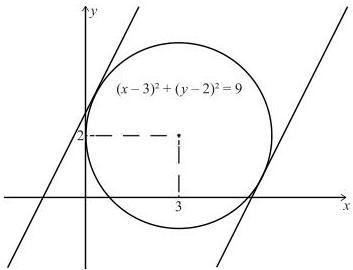
Substitute into the circle equation: . Expanding: . Simplifying: . Setting the discriminant to zero: . Dividing by 4 and rearranging: . Taking the square root: . Solving for gives the two tangent positions.
Shortest Distance
To find the closest distance between a line and a circle, calculate the distance from the centre of the circle to the line and then subtract the radius.
Worked Example: Find the closest distance between the line and the circle .
One method is to translate both. Shift the circle centre to by replacing with and with . The line becomes , or . The circle is .
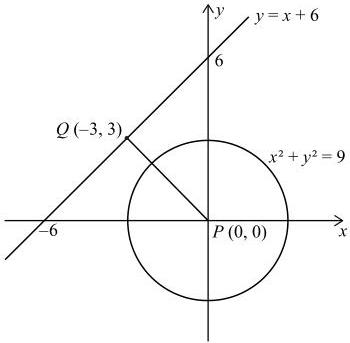
The distance from to the point on the line is . Since the radius is 3, the shortest distance is .
Geometric Circle Properties
You should be able to apply standard circle theorems within the coordinate plane:
- The perpendicular from the centre to a chord bisects the chord.
- The tangent at any point is perpendicular to the radius at that point.
- The angle subtended by an arc at the centre is twice the angle at the circumference.
- The angle in a semicircle is a right angle.
- Angles in the same segment are equal.
- Opposite angles in a cyclic quadrilateral add to .
- The alternate segment theorem: the angle between a tangent and a chord equals the angle in the alternate segment.
Key takeaways
- The product of the gradients of two perpendicular lines is .
- A circle with centre and radius has the equation .
- To identify the centre and radius from a general quadratic equation, you must complete the square for both and variables.
- A line is tangent to a circle if the discriminant of the resulting quadratic equation is zero when solved simultaneously.
- The shortest distance between a line and a circle is found by calculating the distance from the centre to the line and subtracting the radius.
When finding the equation of a line passing through a specific point, use the form. It is often faster and less prone to calculation errors than solving for in .
A common mistake is forgetting that the radius is the square root of the constant on the right hand side of the standard circle equation. If , the radius is 5, not 25.
The relationship connects coordinate geometry to trigonometry. This is why the product of perpendicular gradients is : since the lines are apart, their gradients are and .
Worked Examples
Practice Questions
Frequently asked questions
How do I know if an equation represents a real circle?
After completing the square, the equation must be in the form . For a real circle to exist, must be positive because and the radius must be a real number.
Does the in mean the same thing as in ?
No. In , is the intercept. In the general form , the intercept is actually . Always check which form you are using.
How do I find the gradient between two points?
The gradient is calculated as the change in divided by the change in , or . Be careful to keep the order of coordinates consistent in both the numerator and denominator.