Geometry of 3D Solids for the TMUA
Updated August 2025
Understand the defining characteristics of three dimensional shapes for the TMUA. This guide explains how to identify and count faces, surfaces, edges, and vertices for standard polyhedra and curved solids. Recognising these properties is essential for solving geometric problems involving volume, surface area, and spatial reasoning.
Every three dimensional solid is composed of faces or surfaces, edges, and vertices. For polyhedra, these properties are linked by Euler's Formula: .
Terminology of 3D Solids
When describing three dimensional shapes in the TMUA, you must be precise with your terminology. There are four key terms used to define the boundaries and intersections of a solid.
- Vertex (plural: vertices): A point where three or more edges meet. It is effectively a corner of the solid.
- Edge: A line where two faces or surfaces meet. In polyhedra, these are straight line segments. In curved solids, such as cylinders, they may be circular.
- Face: A flat surface of a solid. Solids consisting entirely of flat faces are known as polyhedra.
- Surface: A more general term for the exterior boundary of a solid. While faces are specifically flat, surfaces can be curved, such as the exterior of a sphere or the side of a cylinder.
Polyhedra: Cubes, Cuboids, Prisms, and Pyramids
Polyhedra are solids with exclusively flat faces. For these shapes, you can always check your counts using Euler's Characteristic: , where is the number of vertices, is the number of edges, and is the number of faces.
Cubes and Cuboids
Cubes and cuboids share the same topological structure. A cube is a special case of a cuboid where all faces are equal squares.
- Faces: 6 flat rectangular (or square) faces.
- Edges: 12 straight edges.
- Vertices: 8 corners.
Prisms
A prism is a solid with a constant cross section throughout its length. The number of faces, edges, and vertices depends on the shape of its base. For a prism with an sided base:
- Faces: (the two bases plus rectangular side faces).
- Edges: (the edges of the two bases plus the edges connecting them).
- Vertices: (the vertices of the two bases).
For example, a triangular prism () has faces, edges, and vertices.
Pyramids
A pyramid has a polygon base and a single vertex (the apex) that is not in the plane of the base. For a pyramid with an sided base:
- Faces: (the base plus triangular side faces).
- Edges: (the edges of the base plus the edges meeting at the apex).
- Vertices: (the vertices of the base plus the apex).
For example, a square based pyramid () has faces, edges, and vertices.
Curved Solids: Cylinders, Cones, Spheres, and Hemispheres
Curved solids do not always follow the same simple counting rules as polyhedra because they possess curved surfaces and may lack vertices or straight edges.
Cylinders
A cylinder can be thought of as a circular prism, though its side is a single curved surface rather than a collection of flat faces.
- Flat Faces: 2 circular faces (the top and bottom).
- Curved Surfaces: 1 side surface.
- Edges: 2 circular edges.
- Vertices: 0.
Cones
A cone has a circular base leading to a single point called the apex.
- Flat Faces: 1 circular face (the base).
- Curved Surfaces: 1 lateral surface.
- Edges: 1 circular edge.
- Vertices: 1 (the apex).
Spheres and Hemispheres
A sphere is perfectly symmetrical and consists of a single continuous boundary.
- Flat Faces: 0.
- Curved Surfaces: 1.
- Edges: 0.
- Vertices: 0.
A hemisphere is a sphere cut in half through its centre.
- Flat Faces: 1 circular face (the cross section).
- Curved Surfaces: 1 (the bowl shaped part).
- Edges: 1 circular edge.
- Vertices: 0.
Key takeaways
- Polyhedra consist only of flat faces, while curved solids feature at least one curved surface.
- For any polyhedron, the number of vertices, edges, and faces must satisfy the formula .
- Prisms and pyramids have properties defined by the number of sides of their base polygon.
- A cylinder has two circular edges and zero vertices, while a cone has one circular edge and one vertex.
When asked to find the properties of a prism or pyramid you have not seen before, always relate it back to the number of sides on its base. This prevents miscounting in a high pressure exam environment.
Be careful when counting the vertices of pyramids. Students often forget to count the apex (the top point) as a vertex, only counting the corners of the base.
The Euler characteristic is a topological invariant for solids that are 'homeomorphic' to a sphere, meaning they have no holes. A doughnut shaped solid (a torus) would have a different characteristic, .
Worked Examples
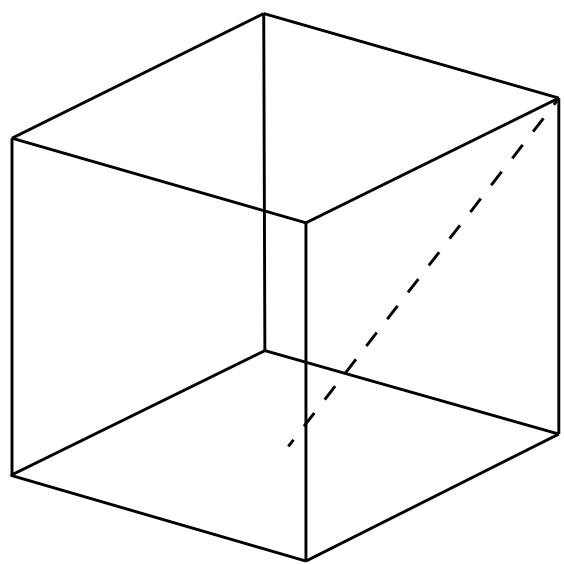
[diagram not to scale]
Practice Questions
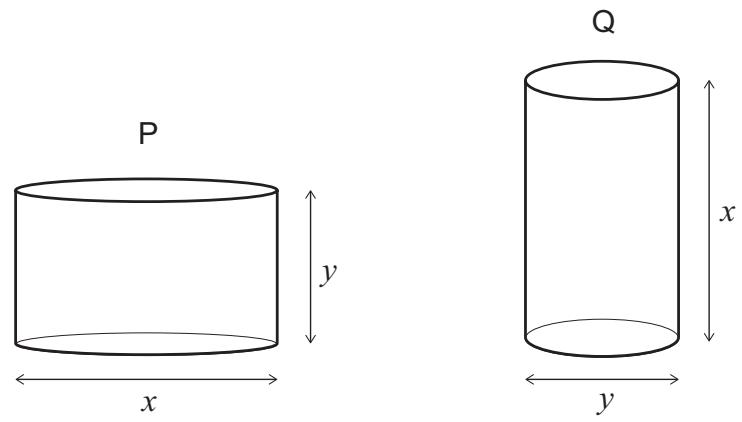
Cylinder P has diameter x and height y.
Cylinder Q has diameter y and height x.
What is the positive difference between the total surface areas of P and Q?
Frequently asked questions
Is the apex of a cone considered a vertex?
Yes. In the context of the TMUA, the apex of a cone is counted as a vertex, as it is the single point where the curved surface terminates.
What is the difference between a face and a surface?
A face specifically refers to a flat, planar boundary of a solid. A surface is a more general term that includes curved boundaries, such as the side of a cylinder or a sphere.
Does a cylinder have edges?
Yes, a cylinder has 2 edges. These are the circular boundaries where the flat circular faces meet the curved side surface.
How many vertices does a hemisphere have?
A hemisphere has 0 vertices. Although it has a circular edge, there are no points where multiple edges meet to form a corner.