Ratio and Proportion Applications in Real Contexts
Updated August 2025
Students must apply ratio concepts to practical problems involving mixing, scaling, and concentrations. This topic is essential for university mathematics admissions as it tests the ability to link different ratios through a common variable and calculate resultant proportions. Understanding these multiplicative relationships allows for efficient problem solving in complex multi-step scenarios.
A ratio expresses a multiplicative relationship between two quantities. If a quantity is times as much as quantity , the relationship can be written as the equation , and the ratio of the quantity of to the quantity of is .
Introduction to Ratio Applications
Ratio and proportion are powerful tools for solving problems in real world contexts. In the Test of Mathematics for University Admission, you are expected to apply these concepts to conversion, comparison, scaling, mixing, and concentrations. A fundamental skill is expressing a multiplicative relationship between two quantities as either a ratio or a fraction.
Multiplicative Relationships
To express a multiplicative relationship, you should first create an equation. If there is times as much of in a mixture as there is of , then the relationship is defined by . This can be written as the ratio (quantity of ) : (quantity of ) = . In fractional form, this relationship is expressed as .
Application of Ratio to Conversion
Conversion problems involve changing a value from one unit to another using a fixed ratio. For example, consider the conversion of dinars to dollars with a ratio of .
Example: Converting Dinars to Dollars
The conversion ratio of dinars to dollars is . How many dollars can you get for dinars?
- Recognise that every dinars are worth dollars.
- Divide the total dinars by the dinar part of the ratio: .
- Multiply this result by the dollar part of the ratio: dollars.
Application of Ratio to Comparison
Comparison problems often require linking two different ratios that share a common third quantity. To solve these, you must ensure the 'linking' quantity has the same number of parts in both ratios.
Example: Comparing Orange and Mango Pur��ee
In a mixture of orange pur��ee, mango pur��ee and water, the ratio by volume of orange pur��ee to water is . The ratio of mango pur��ee to water is . What is the ratio of orange pur��ee to mango pur��ee by volume?
- Identify the linking quantity, which is water. The first ratio is Orange : Water () and the second is Water : Mango ().
- To compare them, the water parts must match. In the first ratio, multiply both sides by so that the water parts become . Thus, becomes .
- Now that water is in both, you can compare orange to mango directly: .
Application of Ratio to Scaling
Scaling involves using a ratio to relate measurements on a model or map to real life dimensions. A scale of means every measurement on the drawing is multiplied by to find the actual measurement.
Example: Park Scale Drawing
A scale drawing is made of a park using a ratio of . The length of the park on the drawing is cm. What is the actual length of the park in km?
- Multiply the drawing length by the scale factor: cm.
- Convert cm to metres: m.
- Convert metres to kilometres: km.
Application of Ratio to Mixing
Mixing problems require calculating the total amounts of specific components when two different mixtures are combined. There are two main methods for this.
Example: Combining Mixtures X and Y
Mixture contains orange concentrate and water in the ratio . Mixture contains orange concentrate and water in the ratio . If litre of and litres of are mixed to form Mixture , what is the ratio of orange to water in ?
Method 1: Volumetric Calculation
- For Mixture ( ml total): parts. One part is ml. Orange = ml, Water = ml.
- For Mixture ( ml total): parts. One part is ml. Orange = ml, Water = ml.
- Total Orange in : ml. Total Water in : ml.
- Ratio Orange : Water in = .
Method 2: Scaling Parts
- Mixture () has parts. To compare, we write Mixture () with the same number of parts, which is .
- Since we have litres of for every litre of , we multiply the components of by .
- The new ratio is .
Application of Ratio to Concentrations
Concentrations relate the volume of one state or substance to another during a process like compression.
Example: Gas Compression
When a gas is compressed to a liquid, the ratio of gas volume to final liquid volume is . How many litres of gas are needed for litre of liquid?
- The ratio means litres of gas produce litres of liquid.
- Divide the gas volume by the liquid parts: litres.
Multiplicative Relationships in Smoothies
Consider a smoothie containing apple juice and mango juice where there is twice as much apple as mango.
- Let be apple and be mango. The equation is .
- The ratio is , which simplifies to .
- The fraction of the smoothie that is apple is .
Key takeaways
- A multiplicative relationship implies a ratio of .
- When combining ratios, find a common multiple for the linking quantity to create a consistent comparison.
- In mixing problems, calculate the actual volumes of each component before summing them.
- Scale drawings use a constant ratio to relate map distances to real distances through multiplication.
- Concentrations can be expressed as a ratio of components or a fraction of the total volume.
When faced with multiple ratios for different parts of a mixture, always identify the 'bridge' variable. This is the component appearing in both ratios. Scale both ratios so the bridge variable has the same numerical value.
Be careful with wording like 'twice as much'. If is twice as much as , then , not . This is a common reversal error that leads to the wrong ratio.
The concept of a 'linking ratio' is essentially the first step in solving systems of proportional equations. It allows you to eliminate a variable or express all variables in terms of a single parameter.
Worked Examples
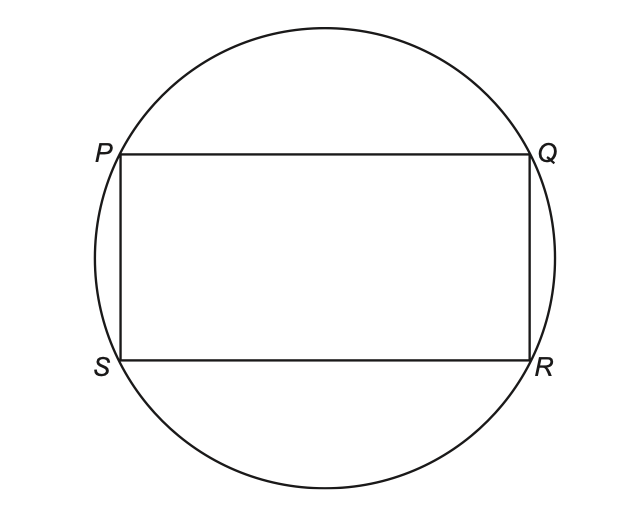
[diagram not to scale]
The ratio of the length of PQ to the length of QR is 2:1
The area of the rectangle PQRS is 96 cm².
What is the radius, in cm, of the circle?
Practice Questions
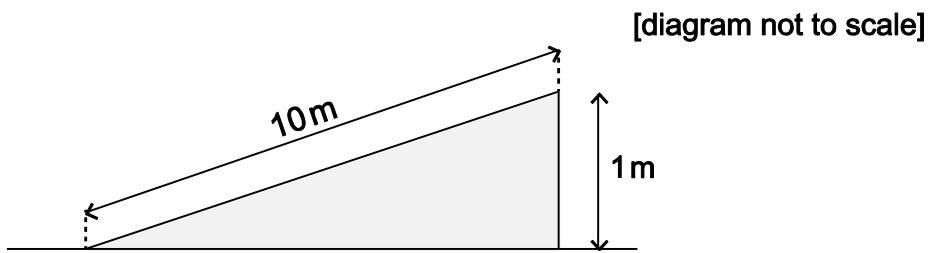
[diagram not to scale]
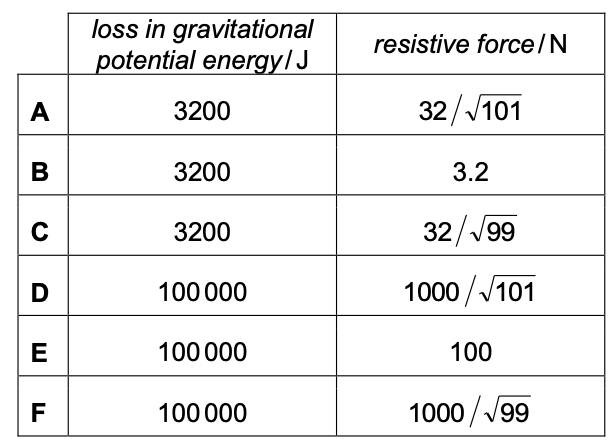
Calculate the loss in gravitational potential energy as the cyclist loses 100 m in vertical height and hence calculate the total resistive force on the cyclist and bike.
(gravitational field strength = )
Frequently asked questions
How do I choose between Method 1 and Method 2 for mixing problems?
Method 1 is safer if the total volumes are known and easy to divide into parts. Method 2 is faster if you are given relative amounts of each mixture and the number of parts can be easily equated.
What if the units are different in a conversion ratio problem?
You must convert both quantities to the same units before simplifying or applying the ratio. Usually, converting to the smaller unit (e.g. cm instead of m) avoids decimals.
How do I turn a ratio into a fraction of the total?
If the ratio is , the fraction for part is . Always add the parts to find the denominator.