Direct and Inverse Proportion for the TMUA
Updated August 2025
Understand how to represent and solve relationships where variables change at a constant ratio or in opposite directions. This topic is essential for the TMUA as it requires setting up equations with proportionality constants and interpreting their corresponding graphs. You will learn to handle linear, power, and inverse relationships accurately.
Variables and are in direct proportion if for a constant , resulting in a straight-line graph through the origin. They are in inverse proportion if , meaning increases as decreases.
Direct Proportion
Direct proportion occurs when one variable increases in proportion to the increase in another. For instance, if one chocolate bar costs , then bars will cost . In this case, the number of bars and the total price are in direct proportion because there is no reduction for bulk buying.
In general, if is directly proportional to , we write the relationship as or as the equation , where is a non-zero constant known as the constant of proportionality. You may use any letter for the constant, though is standard.
Graphs of Direct Proportion
If a graph is plotted of against and they are in direct proportion, the graph must be a straight line that passes through the origin . If the line does not pass through the origin, the variables are not in direct proportion.
Example: Identifying Direct Proportion Graphically
Consider the diagram below showing a graph of against . Is directly proportional to ?
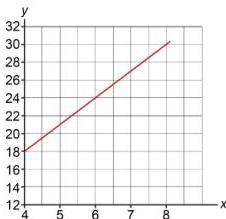
Method 1: By inspection, the graph is a straight line, but it does not pass through the origin. Therefore, is not directly proportional to .
Method 2: Using the equation . From the graph, when , . Substituting these into the formula gives , so . However, if we check another point, such as , we find that . Since is not constant, the relationship is not direct proportion.
Example: Solving Direct Proportion Problems
On days when the temperature is above , the number of ice creams sold in a shop, , is proportional to , where is the temperature in . When the temperature is , the shop sells 30 ice creams. How many will it sell when the temperature is ?
- Set up the equation: .
- Find : Substitute and . This gives , so and .
- Solve for the new value: Substitute and into the equation. ice creams.
Inverse Proportion
If two variables are in inverse proportion, one variable increases as the other decreases. For example, the thickness of ice on a pond might be inversely proportional to the air temperature: as the temperature drops, the ice thickness increases.
We say is inversely proportional to is equivalent to being proportional to . This is written as or .
Graphs of Inverse Proportion
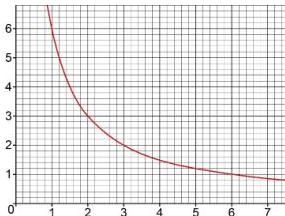
A graph of against for an inverse proportion relationship takes the form of a reciprocal curve, as shown below:
Example: Verifying Inverse Proportion
Is it reasonable to say is inversely proportional to in the following graph?
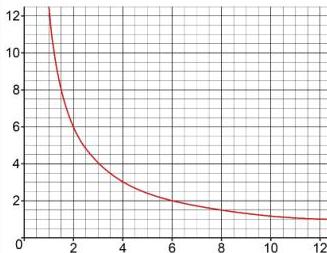
If , then must equal a constant . We check several points:
- When
- When
- When
- When Since is consistently 12, it is reasonable to assume .
Example: Solving Inverse Proportion Problems
The number of pairs of gloves sold, , is inversely proportional to the temperature . When , . Find when .
- Set up the equation: .
- Find : .
- Solve: When , pairs of gloves.
Proportion with Powers
Proportionality can also involve powers of variables, such as or . The general form is for integer or fractional values of .
Example: Proportionality to a Square
The number of water bottles sold, , is proportional to the square of the temperature . At , 72 bottles are sold. How many are sold at ?
- Set up the equation: .
- Find : .
- Solve: When , bottles.
Key takeaways
- Direct proportion implies and a straight line graph passing through .
- Inverse proportion implies and a reciprocal curve graph.
- Always calculate the constant of proportionality using a known pair of values before solving for other variables.
- Proportionality can involve any power of : if , then .
- A graph that is a straight line but does not pass through the origin is not an example of direct proportion.
When given a table of values and asked if the relationship is inverse, quickly multiply and for each pair. If the product is constant, it is inverse proportion. If asked about direct proportion, divide by ; if the quotient is constant, it is direct.
Many students mistake any straight line for direct proportion. Remember: if it does not pass through , it is not direct proportion. Also, ensure you apply the power to the variable before multiplying by (e.g., in , square first).
The relationship is mathematically identical to . This symmetry is why the constant can be found by simply multiplying the two variables together: .
Worked Examples
Practice Questions
Frequently asked questions
What is the difference between being proportional to and being proportional to ?
If , doubling doubles . If , doubling quadruples (since ). The first is a linear relationship, while the second is a quadratic relationship.
Can the constant be negative?
Yes, can be any non-zero real number. However, in most practical TMUA contexts like distance or count, is usually positive.
How do I interpret 'x is inversely proportional to the square root of y'?
This is written algebraically as . To solve, you would square terms or rearrange to isolate or the unknown variable.
Does a line with a negative gradient represent inverse proportion?
No. A straight line with a negative gradient is a linear relationship of the form . Inverse proportion is a curve, not a straight line.