Similarity and Ratios of Length Area and Volume for the TMUA
Updated August 2025
Understanding the mathematical relationship between the lengths, areas, and volumes of similar shapes is a core requirement for the TMUA. This lesson explains how to use linear scale factors to derive area and volume ratios, and how to maintain trigonometric consistency across enlarged or reduced geometric figures.
Two shapes are mathematically similar if one is an enlargement of the other. If the ratio of corresponding lengths is , the ratio of their areas is and the ratio of their volumes is .
Definition of Similarity
If two shapes are mathematically similar, one shape is considered an enlargement of the other. This means they are the same shape and have the same angles in the same order. Crucially, all corresponding sides must be in the same ratio. For example, if every length in triangle A is doubled to create triangle B, the two triangles are similar, and the linear scale factor is 2.
Area and Volume Ratios from a Linear Scale Factor
When two shapes, A and B, are mathematically similar and the lengths of the sides of B are times the lengths of the corresponding sides of A, the following rules apply:
- The area of the surfaces of B are times the areas of the corresponding surfaces of A.
- The volume of B is times the volume of A.
Worked Example: Using a Linear Scale Factor
X is a cube of side cm. Y is a cube of side cm. If the volume of X is 100 cm, what is the volume of Y?
First, identify the linear scale factor. Each length of X is multiplied by 3 to get the length of Y (since ). Because volume scales by the cube of the linear factor, the volume of Y is times the volume of X. Therefore, the volume of Y is cm.
Area and Volume Ratios from a Linear Ratio
If the ratio of corresponding lengths on shape A to those on shape B is , then:
- The ratio of corresponding areas is .
- The ratio of the volumes is .
Worked Example: Ratios of Spheres
The ratio of the diameters of two spheres A and B is . If the surface area of A is 250 cm, find the surface area of B.
Diameter is a linear measure. The ratio of lengths is , which means the ratio of areas is , or . To find the area of B, we use the factor . The area of B is cm.
Calculating Linear Ratios from Area or Volume Ratios
You can work backwards from area or volume information to find linear measurements:
- From Area: If the ratio of the area of B to the area of A is , then the ratio of the lengths is .
- From Volume: If the ratio of the volume of B to the volume of A is , then the ratio of the lengths is .
Worked Example: Length from Area Ratio
Shapes A and B are mathematically similar. The ratio of the area of shape A to the area of shape B is . If the length of shape A is 21 cm, what is the length of shape B?
If the ratio of areas is , the ratio of lengths is , which is . Since the length of A is 21 cm, the length of B is cm.
Worked Example: Area from Volume Ratio
The volume of a cylinder, P, is 64 times the volume of a mathematically similar cylinder, Q. The surface area of Q is 300 cm. What is the surface area of P?
To move from a volume ratio to an area ratio, you must find the linear ratio first. The ratio of volumes is . The ratio of corresponding lengths is , which is . Now, we use this linear ratio to find the area ratio: . If the area of Q is 300 cm, the area of P is cm.
Similarity, Trigonometric Ratios and Scale Factors
If a right-angled triangle ABC is enlarged by a scale factor to form triangle DEF, the angles and trigonometric ratios are preserved. They do not depend on the scale factor because the ratio of two sides remains the same.

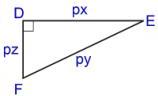
In the diagrams above, and . Since , angle C must equal angle F. This applies to all trigonometric ratios including and .
Worked Example: Trigonometry in Similar Triangles
Triangle DEF is an enlargement of triangle ABC with scale factor 4. The sides of triangle ABC have lengths and , with . In triangle DEF, . What is the sine of angle DFE in terms of and ?

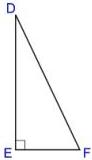
Because triangle DEF is an enlargement of triangle ABC, the two triangles are similar and their corresponding angles are equal. Angle A corresponds to angle D (both opposite the shortest sides), meaning angle C corresponds to angle F. Thus, .
Key takeaways
- Mathematically similar shapes have equal corresponding angles and sides in the same ratio.
- If the linear scale factor between two similar shapes is , the area scales by and the volume scales by .
- To find a length ratio from a volume ratio, always calculate the cube root of the volume ratio first.
- Trigonometric ratios such as , , and are invariant under enlargement or reduction.
In TMUA questions involving 3D similarity, candidates often forget to find the linear ratio before moving between area and volume. Always write down the linear, area, and volume ratios as a set (e.g. , , ) to avoid calculation errors.
Do not confuse the scale factor for area with the scale factor for length. If a map has a scale of , the area of a region on the map is not of the real area, but .
Similarity is a fundamental concept in geometry that connects algebra to spatial reasoning. The fact that , , and govern these relationships is a direct consequence of the number of dimensions being measured: 1D for length, 2D for area, and 3D for volume.
Worked Examples
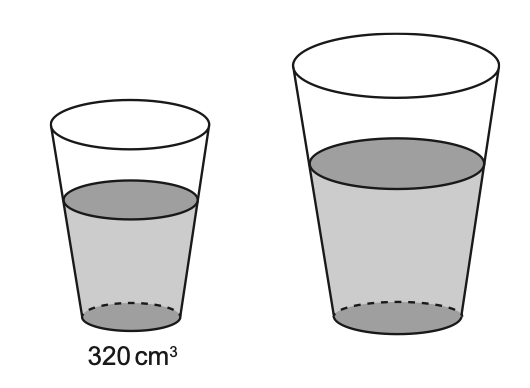
[diagram not to scale]
At a cinema, drinks are sold in regular and large sizes.
The cups for these are mathematically similar.
The ratio of the heights of the cups and the ratio of the depths of the drinks are both 4:5
The volume of drink in a regular size cup is 320 cm³.
What is the volume, in cm³, of drink in a large size cup?
Practice Questions
Frequently asked questions
Does a scale factor have to be an integer?
No, a scale factor can be any positive real number. For example, a scale factor of means the image is half the size of the object. The rules for area () and volume () still apply.
Can I calculate the volume ratio directly from the area ratio?
It is safer to find the linear ratio first. If the area ratio is , the linear ratio is . You can then cube these linear values to find the volume ratio.
Why are trigonometric ratios the same in similar triangles?
Trigonometric ratios are defined as the ratio of two side lengths. Since similarity multiplies all side lengths by the same scale factor , the values in the numerator and denominator cancel out, leaving the ratio unchanged.