Differentiation of Rational Powers for the TMUA
Updated August 2025
Differentiation measures the rate at which one variable changes with respect to another. For the TMUA, you must master the power rule for all rational exponents and be able to simplify complex algebraic fractions before differentiating to find gradients and stationary points.
The derivative of is given by for any rational . This derivative represents the gradient of the tangent to the curve at any given point and describes the rate of change of the function.
Differentiation is a fundamental tool in calculus used to determine the rate of change of a function. In the context of the TMUA, you are expected to understand its geometric interpretation as the gradient of a tangent and its algebraic application to polynomial-style expressions.
Derivatives as Rates of Change
A derivative tells you how fast one variable changes relative to another. For example, speed is the rate of change of distance with respect to time. If an object travels at 3 metres per second, its distance increases by 3 units for every 1 unit of time. In a coordinate plane, the gradient of a curve at a point tells us how much changes for every 1 unit change in . This is interpreted geometrically as the gradient of the tangent to the curve at that specific point.
You must be familiar with the following notation:
- and (Leibnitz notation for the first and second derivatives).
- and (Function notation).
- In mechanics, a dot above a variable (e.g. for speed) indicates differentiation with respect to time, though this is less common in TMUA Paper 1.
The Power Rule for Rational Exponents
The primary rule for differentiation in this specification is the power rule. For any expression in the form , where is a rational number:
When differentiating a sum or difference of terms, you simply differentiate each term individually and add or subtract the results. For example:
Note that the derivative of a constant term (like 11) is always 0, as constants do not change with respect to .
Simplification Before Differentiating
Many TMUA questions provide expressions that do not immediately look like a sum of terms. Since advanced rules like the product rule or quotient rule are not required for this specification, you must simplify the expression algebraically first. This typically involves expanding brackets or dividing through by a common denominator.
Worked Example: Differentiating an Algebraic Fraction
Differentiate with respect to .
- First, expand the numerator: .
- Rewrite the function by dividing each term in the numerator by the denominator: .
- Simplify to index form: .
- Now, apply the power rule to each term: .
- Final result: or .
Stationary Points and Second Derivatives
Stationary points occur where the tangent to a curve is horizontal, meaning the gradient is zero. To find these points, you solve:
Once a stationary point is found, you must classify it as a local maximum or a local minimum. The second derivative, , measures how the gradient itself is changing:
- If at the stationary point, the gradient is increasing, signifying a minimum.
- If at the stationary point, the gradient is decreasing, signifying a maximum.
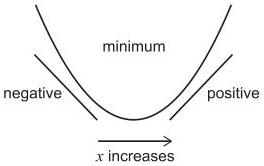
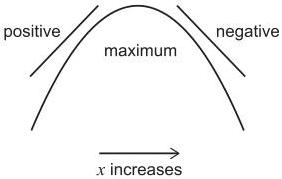
Note that if , the test is inconclusive. The point could be a maximum, a minimum, or a point of inflexion (such as in the case of or ).
Increasing and Decreasing Functions
A function is strictly increasing on an interval if its gradient is always positive throughout that interval (). Conversely, it is strictly decreasing if its gradient is always negative ().
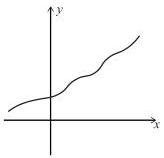
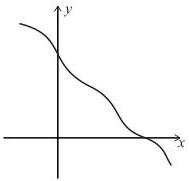
While points of inflexion will not be examined in detail, you should qualitatively understand that they represent a point where the curve changes its concavity, such as the origin in the graph of .
Key takeaways
- The power rule applies to all rational powers, including negative and fractional indices.
- Always simplify complex algebraic fractions or bracketed expressions into a sum of terms before attempting to differentiate.
- Stationary points are found by setting the first derivative to zero, .
- A positive second derivative at a stationary point indicates a minimum, while a negative second derivative indicates a maximum.
- Strictly increasing functions satisfy , while strictly decreasing functions satisfy .
In TMUA questions, if you see a fraction with a single term in the denominator, always divide through every term in the numerator by that denominator. This allows you to differentiate using only the power rule, avoiding the quotient rule entirely.
Be careful with signs when differentiating negative powers. For example, the derivative of is . A common mistake is to write because of a misunderstanding of how the power is reduced by one.
The relationship between stationary points and is about concavity. means the function is 'convex' (holds water), leading to a minimum. means the function is 'concave' (sheds water), leading to a maximum.
Worked Examples
Practice Questions
Frequently asked questions
Can I use the power rule on roots like ?
Yes. First, convert the root to index form: . Then apply the power rule to get or .
How do I find the equation of a normal to a curve?
First, find the gradient of the tangent, , by calculating at the given point. The gradient of the normal is the negative reciprocal, . Then use .
What if the second derivative is zero at a stationary point?
If , the second derivative test is inconclusive. You should check the gradient slightly to the left and right of the point to determine if it is a maximum, minimum, or a horizontal point of inflexion.