Algebraic Techniques and Polynomial Roots for the TMUA
Updated September 2025
This guide teaches how to determine exactly where a graph crosses the coordinate axes using algebraic methods. It also explores the relationship between the degree of a polynomial and the number of real roots it can possess, which is essential for accurate graph sketching in the TMUA.
To find axis intersections for a function , set for the -intercept and solve for the -intercepts. A polynomial of degree can possess at most real roots.
Determining Intersections with the Coordinate Axes
To sketch a function accurately or solve geometric problems, you must be able to identify where the graph intersects the coordinate axes. This is achieved through two distinct algebraic processes.
-
The y-intercept: This is the point where the graph crosses the vertical axis. Since the -axis is defined by the equation , you find the -coordinate by evaluating . For a polynomial such as , the -intercept is always the constant term .
-
The x-intercepts: These are the points where the graph crosses the horizontal axis, also known as the roots of the function. Since the -axis is defined by the equation , you must solve the equation . For linear functions, this is a simple rearrangement. For quadratics, you may use factorisation, completing the square, or the quadratic formula. For higher-degree polynomials, you typically use the Factor Theorem, which states that if , then is a factor of .
Possible Numbers of Real Roots in Polynomials
The degree of a polynomial, which is the highest power of it contains, dictates the maximum number of times the graph can intersect the -axis. It is important to appreciate the variety of shapes these graphs can take.
- Quadratics (Degree 2): These are U-shaped or n-shaped curves. As seen in earlier sections, they can have two distinct real roots, one repeated root (where the graph just touches the axis), or no real roots at all (if the discriminant ).
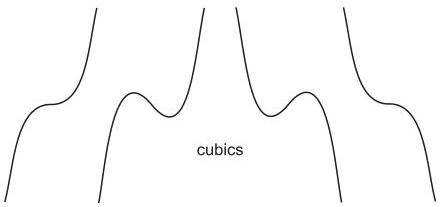
- Cubics (Degree 3): These functions can have one, two, or three real roots. Because the end behaviour of a cubic function involves as and as (for a positive leading coefficient), a cubic must cross the -axis at least once. This means every cubic has at least one real root.
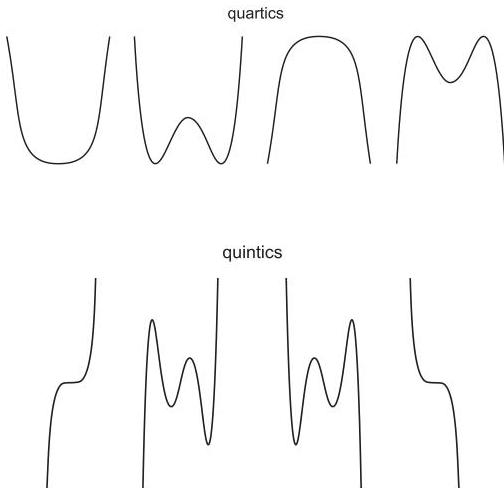
- Quartics (Degree 4): These can have between zero and four real roots. Like quadratics, a quartic might stay entirely above or below the -axis.
- Quintics (Degree 5): These can have between one and five real roots. Like cubics, their odd degree ensures they must cross the -axis at least once.
Below are examples of the variety of shapes for cubics, quartics, and quintics:
Leading Coefficients and Graph Behaviour
The coefficient of the highest power of (the leading coefficient) determines the overall orientation and end behaviour of the graph.
For a polynomial :
- If is even and , both ends of the graph head towards . If , both ends head towards .
- If is odd and , the graph starts at (bottom left) and ends at (top right). If , it starts at (top left) and ends at (bottom right).
Appreciating these patterns allows you to quickly determine if your algebraic results for roots make sense when compared to the general shape of the function. For example, a quartic with a positive coefficient and a negative -intercept must have at least two real roots, as it must cross the axis to reach the positive infinities at either end.
Key takeaways
- To find the y-intercept, evaluate ; to find x-intercepts, solve .
- A polynomial of degree has a maximum of real roots.
- Polynomials of odd degree must have at least one real root.
- The leading coefficient and the degree together determine the end behaviour of the graph as .
- A repeated root (e.g., ) corresponds to a point where the graph touches the x-axis but does not cross it.
When solving for -intercepts in the TMUA, always check if the leading coefficient is negative. It is a common mistake to misidentify the end behaviour or the direction of the curve by assuming a positive leading coefficient.
Do not assume the number of roots is always equal to the degree. The degree is only the MAXIMUM possible number of roots. A quartic (degree 4) can have zero roots if it is shifted entirely above the x-axis.
The relationship between the degree of a polynomial and its roots is a fundamental part of the Fundamental Theorem of Algebra. While we only look at real roots for the TMUA, every polynomial of degree has exactly complex roots when counted with multiplicity.
Frequently asked questions
Can a cubic polynomial ever have no real roots?
No. Because a cubic function goes from negative infinity to positive infinity (or vice versa), it must cross the -axis at least once. Therefore, it always possesses at least one real root.
How can I tell if a quadratic has one, two, or no roots without sketching it?
Use the discriminant, . If it is greater than zero, there are two roots: if it is zero, there is one repeated root: if it is less than zero, there are no real roots.
Is the constant term always the y-intercept for any function?
For polynomials, yes. For other functions like or , you must evaluate the function at . Note that some functions, such as or , are not defined at and thus have no y-intercept.
What does a repeated root look like on a graph?
A repeated root of even order (like ) looks like a turning point that just touches the -axis. A repeated root of odd order (like ) creates a horizontal point of inflexion on the -axis.