Transformations and Compositions of Functions
Updated August 2025
Master the effect of transformations on the graph of for university admissions tests. This guide explains vertical and horizontal translations, stretches, and squashes, including how to combine these operations and use composite function notation to analyse complex curves accurately.
A transformation maps the graph of to a new position or shape. Vertical changes and affect the coordinates directly, while horizontal changes and modify the input and often produce a counter-intuitive effect on the graph.
Introduction to Transformations
Graph transformation is a topic that is often poorly understood because students frequently learn rules without grasping the underlying mechanics. It is particularly tricky because horizontal shifts like appear as though they should shift a graph to the right, yet they actually move it to the left when is positive. To truly master this topic for the TMUA, you must understand how the notation identifies the value above a given coordinate as the result of a calculation, and how modifications to that calculation affect the resulting curve.
Vertical Stretch:
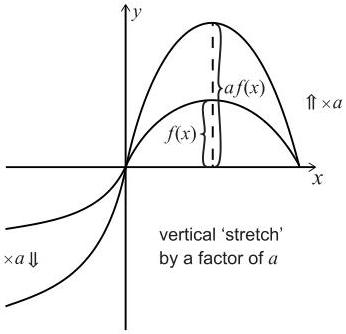
In the transformation , every original value is multiplied by the factor . For example, if we compare with , each value is four times as large. This corresponds to a vertical stretch away from the axis by a factor of .
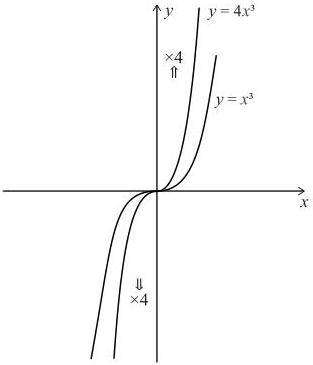
If , the graph becomes less tall (a compression towards the axis). If is negative, the graph is reflected in the axis in addition to the vertical stretch.
Vertical Translation:
Adding a constant to the function result, as in , shifts every point on the graph up by units. This is a translation by the vector . For instance, moving from to shifts the entire parabola up by 3 units parallel to the axis.
Horizontal Translation:
This transformation shifts the graph parallel to the axis. To find the expression for given , replace every in the original function with .
Worked Example 1 Given , find an expression for . Substituting for : .
Worked Example 2 Given , find an expression for . Replacing with : .
Note that the 2 multiplies the entire replacement: we must have and not .
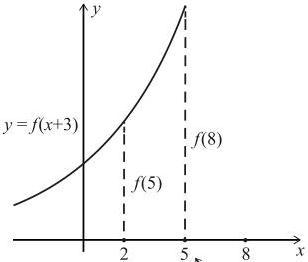
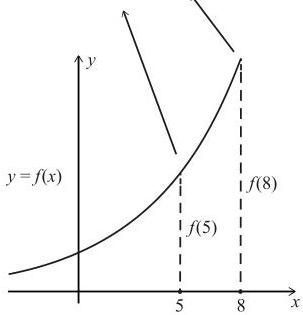
Understanding the Shift Consider . In , gives . In , gives . The value found at on the original graph now appears at on the new graph. This means the graph of is the graph of translated by . If is positive, it moves left.
Horizontal Squash:
In , the value above a given is the value that would have occurred at in the original function. If , the values occur at half the distance from the axis, effectively 'squashing' the graph towards the axis by a factor of .
Worked Example 3 Given , find . Replacing by : .
Worked Example 4 Given , find . Replacing by : .
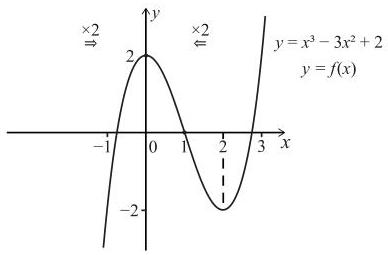
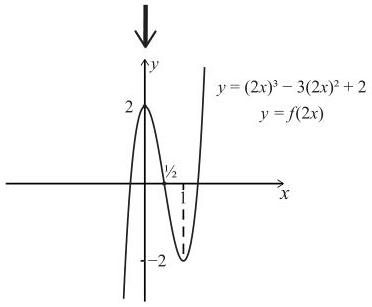
Summary of Transformations
| Transformation | Effect |
|---|---|
| Vertical stretch away from the axis by factor . If , includes reflection in axis. | |
| Translation by (Vertical shift). | |
| Translation by (Horizontal shift). | |
| Horizontal squash towards the axis by factor . If , includes reflection in axis. |
Combining Transformations and Composite Functions
Order matters when combining transformations. Consider . If we translate by then squash by factor 2, we get: . This is correct. However, squashing by 2 then translating by gives: . This is incorrect.
Composite Function Notation The notation means taking the output of and using it as the input for .
Worked Example 5 Let and . To find , replace the input in with : .
Key takeaways
- Horizontal transformations and generally have the opposite effect to what is intuitive: shifts left and multiplying by squashes the graph.
- Vertical transformations and affect the coordinates directly and behave intuitively.
- Order is critical when combining transformations: for horizontal changes, apply the translation then the stretch, or factorise the argument to .
- Composite notation involves substituting the entire expression for into every instance of within .
When transforming trigonometric graphs, keep the period in mind. For , the new period is the original period ( or ) divided by .
Always be careful with brackets when substituting for . In , the factor must multiply everything substituted for . Forgetting brackets is the most common cause of errors in transformation questions.
Thinking of transformations as mappings of individual points can help clarify complex compositions. For , the point on the original graph maps to on the new graph.
Worked Examples
Practice Questions
Frequently asked questions
Why does move the graph to the left instead of the right?
Because the value that used to occur at now occurs when , which means . Every point must exist at an value that is units smaller to produce the same function input.
How do I handle a negative in ?
A negative represents two distinct transformations: a horizontal squash by a factor of and a reflection in the axis.
Is always the same as ?
No, function composition is not generally commutative. For example, if and , then while .