Graphs of Functions: Transforming Completed Square Forms
Updated August 2025
Learn how the coefficients in the completed square form transform the standard quadratic curve . This essential topic for the TMUA covers vertical and horizontal translations, scaling, and reflections, allowing you to identify the vertex and line of symmetry instantly.
The graph of is a transformed version of where determines vertical translation, determines horizontal translation, and determines vertical scaling and reflection.
Transforming the Parent Quadratic
To understand how altering the values of , , and affects the graph of , we must view the expression as a series of transformations applied to the parent function . Each coefficient performs a specific geometric operation on the curve.
Breaking Down the Transformations
There are two primary ways to conceptualise the construction of the graph from the starting point . We usually assume .
Sequence 1: Horizontal Scaling Approach (for )
- Start with the parent function: .
- Apply a horizontal squash towards the -axis by a factor of : .
- Translate the graph horizontally by units: .
- Translate the graph vertically by units: .
Sequence 2: Vertical Scaling Approach (General Case)
- Start with the parent function: .
- Apply a vertical stretch away from the -axis by a scale factor of : .
- Translate the graph horizontally by units: .
- Translate the graph vertically by units: .
You should verify that both methods produce the same final graph by testing values like . In the first method, we use , which is a horizontal squash. In the second, we use , which is a vertical stretch. For the specific case of the quadratic , these operations are equivalent.
Dealing with Negative Coefficients
When is negative, the first sequence becomes more complex because we cannot take the square root of a negative number. In this case, we must introduce an additional reflection step:
- Start with .
- Apply a horizontal squash by factor : .
- Reflect the graph in the -axis to account for the negative sign: .
- Apply translations for and as before.
While technically correct, this is often cumbersome. It is usually simpler to treat the multiplication by as a single vertical transformation that includes both a stretch by factor and a reflection in the -axis if .
Geometric Features of the Transformed Graph
By understanding these transformations, we can immediately identify the key features of the quadratic curve without extensive calculation:
- The Vertex (Turning Point): On the parent graph , the vertex is at . After a horizontal translation by and a vertical translation by , the vertex moves to the point .
- The Line of Symmetry: The line of symmetry for is . In the transformed graph, this becomes the vertical line .
- Orientation: If , the graph is a U-shape (concave up). If , the graph is an inverted U-shape (concave down).
You are encouraged to pick different sets of values for , , and and use a graph sketching package to follow through these transformations step by step. This will help you justify the position and shape of any quadratic curve encountered in the TMUA.
Key takeaways
- The vertex of the quadratic is always located at .
- A positive shifts the graph to the left, while a negative shifts it to the right.
- The coefficient scales the graph vertically: makes the curve narrower, while makes it wider.
- The constant is a direct vertical translation, shifting the entire curve up or down.
In TMUA questions, if you are given a quadratic in expanded form , always complete the square first. This immediately gives you the transformation parameters and the coordinates of the turning point.
The most common error is the direction of the horizontal shift. Remember that moves the graph of to the left by 3 units, not the right. Always check by finding the value of that makes the bracket zero.
This completed square form is a perfect example of how algebra and geometry are linked. The algebraic process of completing the square is geometrically equivalent to finding the unique translation and stretch that maps the standard parabola onto the specific curve in the problem.
Worked Examples
Practice Questions
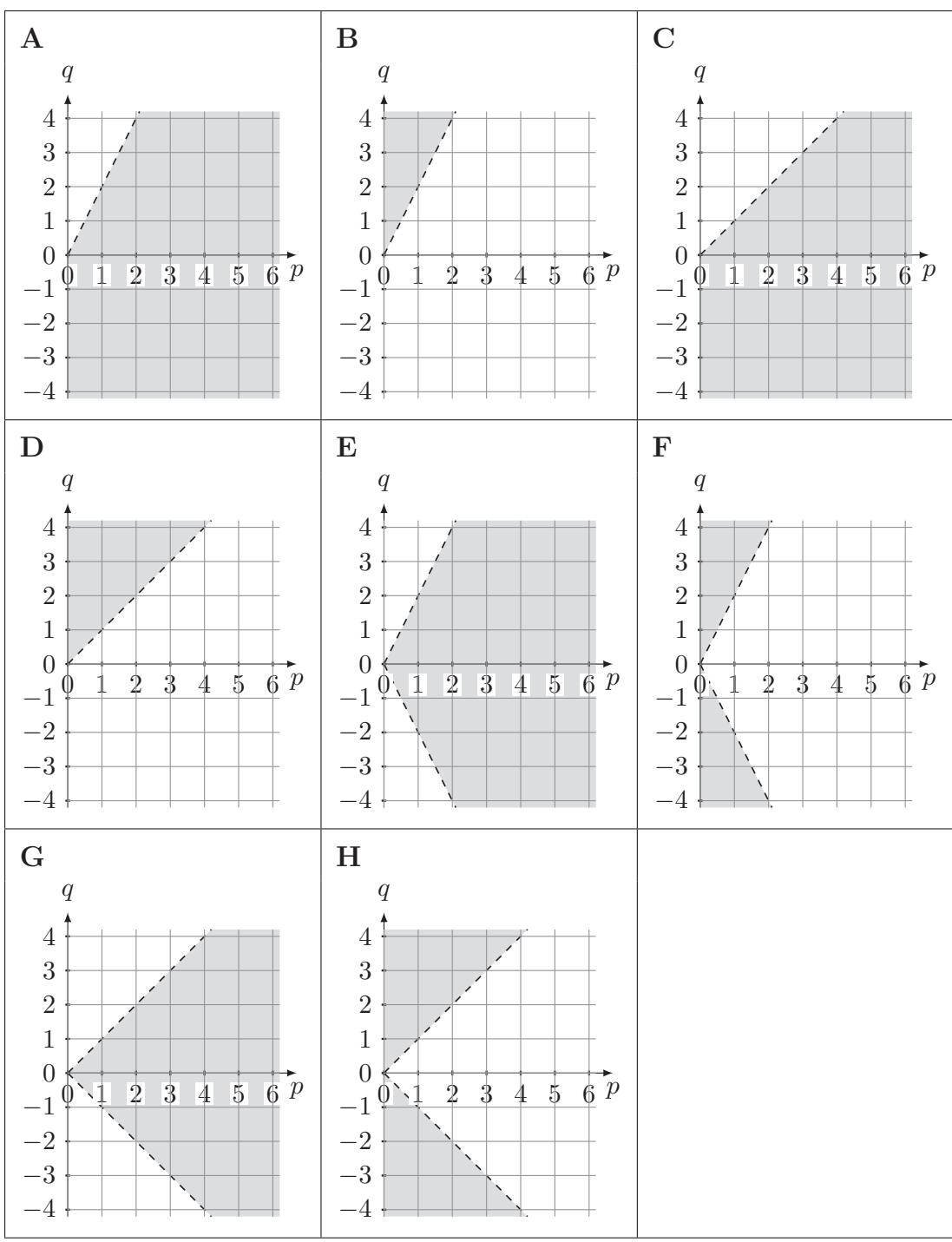
where , intersects the -axis at two distinct points.
In which one of the following graphs does the shaded region show the complete set of possible values that and could take?
Frequently asked questions
Why is the horizontal shift and not ?
The notation means the -value at a given is what the original function achieved units further along the -axis. To bring that value back to your current , the entire graph must shift backwards, or to the left, by units.
How does affect the roots of the quadratic?
If and have opposite signs, the graph must cross the -axis, meaning the quadratic has two real roots. If they have the same sign, the vertex is above the -axis and opens upwards, or below and opens downwards, resulting in no real roots.
Does the order of transformations matter?
Yes. Usually, we apply the scaling (stretch) and horizontal shift before the vertical shift . If you were to translate vertically first and then stretch by , the constant would also be multiplied by , changing the final equation.