Definite Integration and Area for the TMUA
Updated August 2025
Master the critical distinction between finding a definite integral and calculating the area between a curve and an axis. For the TMUA, you must understand how to handle regions where the function is negative, ensuring geometric area is calculated as a positive quantity while integrals remain signed.
A definite integral calculates the signed area under a curve, where regions below the x axis contribute negatively. Geometric area is the absolute magnitude of space between the curve and the axis, requiring separate calculation of negative regions.
Introduction to Integration
There are two primary ways to conceptualise integration. These methods are deeply related, though the specific mechanics of that relationship are beyond the scope of the TMUA.
First, integration is the reverse of differentiation. It identifies what function must have been differentiated to produce a given expression. This is written as an indefinite integral:
We include the constant of integration, , because the derivative of any constant is zero. Thus, multiple functions can share the same derivative.
Second, integration can be viewed as finding the area between a curve and the axis. When we use numbers at the top and bottom of the integral sign, called limits, we are performing definite integration:
Definite Integration as Signed Area
In definite integration, the term area must be used with caution. Geometric area is traditionally a positive value, but a definite integral calculates a signed sum. It sums the areas above the axis and subtracts the areas below it in a single calculation.
This occurs because integration can be modeled as the sum of infinitely thin rectangles of width and height . For regions below the axis, the values are negative, so the product contributes a negative value to the total integral.
Worked Example 1
Calculate and illustrate the result.
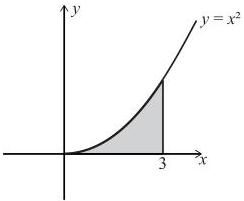
Worked Example 2
Calculate and illustrate the result.
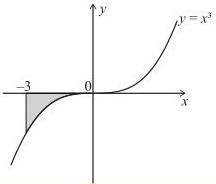
Worked Example 3
Calculate and illustrate the result.
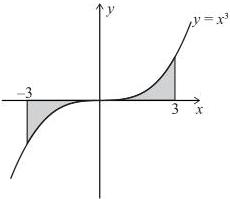
The answer is zero because the function is antisymmetric. the negative area between and perfectly cancels the positive area between and .
The Difference Between Integrals and Geometric Area
If a TMUA question asks for the area between a curve and the axis, a single definite integral across the whole range will likely give the wrong answer if the curve crosses the axis. To find the total geometric area, you must:
- Identify the roots of the function to see where it crosses the axis.
- Calculate the definite integral for each region separately.
- Take the absolute (positive) value of each result.
- Add these positive values together.
Worked Example: Finding Total Area
Find the area between the axis, the lines and , and the curve .
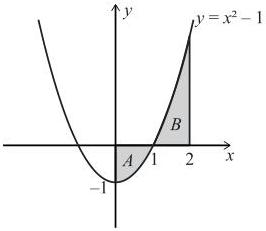
We must split the calculation at the root .
For Region A (from to ):
For Region B (from to ):
Area A is (positive magnitude) and Area B is . The total area is . Note that the single definite integral would have given , which is the signed sum, not the total area.
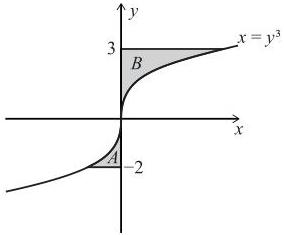
Integration with respect to y
You may also encounter integrals with respect to , such as . These are calculated using the same power rules as , but the regions are measured between the curve and the axis.
Integration Symmetry Tricks
Symmetry can significantly simplify definite integrals.
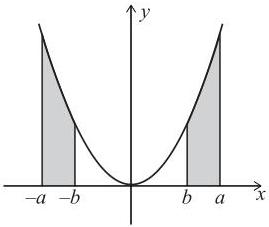
Symmetric (Even) Functions: If is symmetric about the axis, then . This applies to functions like or .
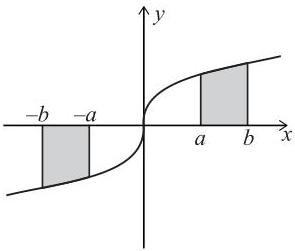
Antisymmetric (Odd) Functions: If is antisymmetric (reflecting in and then returns the same curve), then . This applies to , , and .
Key takeaways
- Definite integrals calculate signed area, subtracting regions below the x axis.
- Geometric area is always positive and requires splitting integrals at roots.
- Antisymmetric functions integrated over a symmetric interval about zero always result in zero.
- Symmetric functions integrated over a symmetric interval about zero are equal to twice the integral from zero to the upper limit.
Always sketch the graph before calculating an area. TMUA questions often hide the fact that a curve crosses the x axis, leading students to calculate a single integral that underestimates the total geometric area.
Do not confuse the indefinite integral constant with definite integration. In definite integration, the constant cancels out during the subtraction , so it is usually omitted.
The relationship between symmetry and integration is a powerful tool for competitive tests. For example, knowing is an odd function allows you to immediately state that without performing any calculus.
Worked Examples
Practice Questions
Frequently asked questions
Can a definite integral be negative?
Yes. A definite integral is negative if the net area under the curve is greater below the x axis than above it.
What is the physical meaning of the 'dx' in an integral?
The represents an infinitesimal width along the x axis. When multiplied by the height , it represents the area of one of the infinitely many thin rectangles being summed.
How do I know if I need to split my integral to find the area?
Sketch the function and solve . If any roots lie within your limits of integration, you must split the integral at those points to calculate geometric area correctly.