Trigonometry for the TMUA
Updated August 2025
Master the essential laws governing non-right-angled triangles. This lesson covers the sine and cosine rules, the trigonometric formula for triangle area, and the complexities of the ambiguous case. These tools allow you to solve geometric problems in both two and three dimensions.
The sine and cosine rules relate the side lengths and interior angles of any triangle, extending Pythagoras' theorem and right-angled trigonometry to all geometric scenarios.
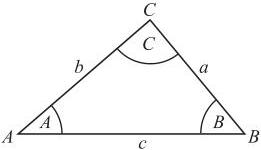
Trigonometry in the TMUA often requires applying relationships between sides and angles in triangles that are not right-angled. To do this, we use a standard labelling convention: corners are labelled with capital letters , , and , while the sides opposite them are labelled with corresponding lower-case letters , , and .
The Area of a Triangle
The most fundamental formula for the area of a triangle is , or .
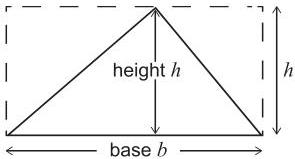
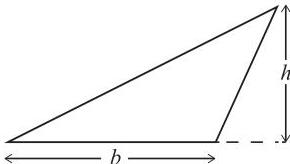
This formula holds even if the top corner is not directly above the base. In such cases, one must be careful to use the vertical height above the horizontal base rather than a slanted height. This can be visualised by adding an identical triangle to form a parallelogram.
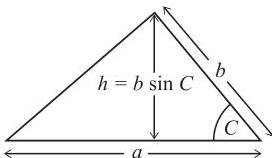
Using trigonometry, we can calculate the vertical height if it is not provided. In the diagram below, the height can be expressed as . Substituting this into the area formula gives a version that uses two sides and the included angle:
The Sine Rule
The sine rule is essentially a statement that the area of a triangle is constant regardless of which base and angle you choose for the calculation. Since the area can be written as , , or , we can set them equal:
Multiplying by 2 and dividing by yields the standard form of the sine rule:
Alternatively, it can be written as . You use this rule when given two angles and one side (to find another side) or two sides and one non-included angle (to find another angle).
The Ambiguous Case of the Sine Rule
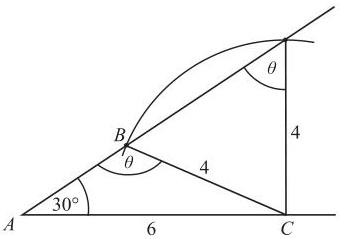
When using the sine rule to find an angle given two sides and a non-included angle, an 'ambiguous' result can occur. This happens because for any value of , there are two possible angles between and that satisfy it: and .
Example: In triangle , angle , side , and side . Find angle .
Using the sine rule:
Calculated values for are or . Both are plausible because and .
The Cosine Rule
The cosine rule acts as a more general form of Pythagoras' theorem. In a right-angled triangle, .
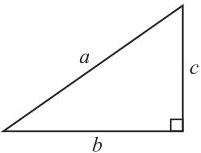
If the angle is not , we require a correction term. By considering the coordinates and projections of the sides, we derive:
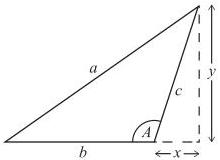
This rule is used when you are given all three sides and want to find an angle, or when you are given two sides and the angle between them to find the third side. The rearranged form for finding an angle is .
Two and Three Dimensions
These rules are not limited to 2D triangles. In 3D problems, you should identify right-angled or non-right-angled triangles within the shape. Often, a side length calculated in one triangle (e.g., on the base of a pyramid) becomes a known side for a second triangle (e.g., a vertical cross-section).
Key takeaways
- The area of any triangle is , where is the included angle.
- Use the Sine Rule when given two angles and a side, or two sides and an angle not between them.
- The ambiguous case occurs when the sine rule yields two possible angles that both satisfy the sum rule.
- Use the Cosine Rule () when given two sides and the included angle.
- In 3D problems, look for 2D triangles embedded within the structure to apply these rules step-by-step.
In the TMUA, try to keep your answers in exact form (e.g., using ) for as long as possible. This avoids rounding errors and often leads to simplifications in multi-step 3D problems.
A common mistake in the ambiguous case is forgetting to check if the obtuse angle is actually possible. If the sum of the given angle and the new obtuse angle exceeds , then only the acute solution is valid.
The Sine Rule can be linked to the circumradius () of the triangle. Specifically, . This is proven by drawing a diameter through one vertex and using the circle theorem that the angle in a semi-circle is a right angle.
Worked Examples
Practice Questions
Frequently asked questions
How do I know whether to use the Sine Rule or the Cosine Rule?
Use the Cosine Rule if you have three sides (SSS) or two sides and the angle between them (SAS). Use the Sine Rule for all other cases, such as two angles and one side (AAS) or two sides and a non-included angle (SSA).
Why does the ambiguous case only happen with the Sine Rule?
The ambiguous case occurs because the function is positive for both acute and obtuse angles. The function, however, is positive for acute angles and negative for obtuse angles, so the Cosine Rule identifies the specific angle uniquely.
What happens to the Cosine Rule if the angle is ?
If , then . The formula simplifies to , which is Pythagoras' theorem.