Coordinate Geometry of the Circle for the TMUA
Updated August 2025
Learn the algebraic representation of circles in the (x,y) plane. This guide covers the two standard forms of circle equations, the method of completing the square to find the centre and radius, and how to determine the interaction between circles and straight lines.
A circle is defined as the set of all points at a constant distance from a fixed centre . Algebraically, this is derived from Pythagoras Theorem as .
Coordinate geometry allows us to describe a circle algebraically. Every point on a circle shares a specific relationship based on its distance from the centre.
Defining the Circle at the Origin
Consider a circle with its centre at the origin and a radius of 1. By definition, every point on this circle is exactly 1 unit away from the origin. Using Pythagoras Theorem, we can see that for any point on the circumference, the horizontal distance is and the vertical distance is .
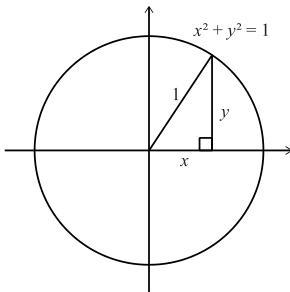
Thus, the equation of the unit circle is . Points inside the circle satisfy the inequality , while points outside satisfy . If we increase the radius to , the equation becomes .
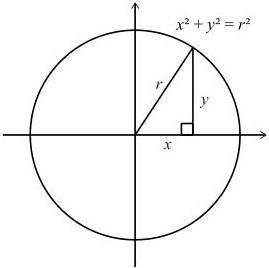
The General Equation in Standard Form
If the centre of the circle is moved from the origin to a general point , we can find the equation using graph shifting or Pythagoras Theorem. Any point on the circle must be a distance from .
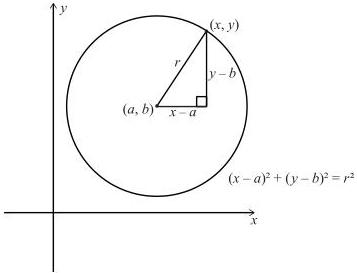
This leads to the standard form of the circle equation:
You must be able to identify the radius and centre immediately from this form. For example:
- The circle has its centre at and a radius of 5 (the square root of 25).
- The circle has its centre at and a radius of .
The Expanded Form and Completing the Square
Circles are often given in the expanded form: . To find the centre and radius, we use the method of completing the square for both the and terms.
Worked Example 1
Find the centre and radius of .
- Group terms: .
- Complete the square for : .
- Complete the square for : .
- Combine: .
- Rearrange: .
The centre is at and the radius is .
Worked Example 2: Non Circles
Consider . Completing the square gives , which simplifies to . Since the sum of squares cannot be negative, there are no real coordinates that satisfy this equation. It is not a circle.
Worked Example 3: Different Coefficients
Find the centre and radius of . First, divide the entire equation by 2 to ensure the and coefficients are 1: . Completing the square results in , or . The centre is and the radius is .
Tangents and the Discriminant
A line is tangent to a circle if it intersects it at exactly one point. To solve problems involving tangents, we substitute the line equation into the circle equation and apply the discriminant condition to the resulting quadratic.
Worked Example: Finding Tangent Constants
Find the values of for which is tangent to the circle .
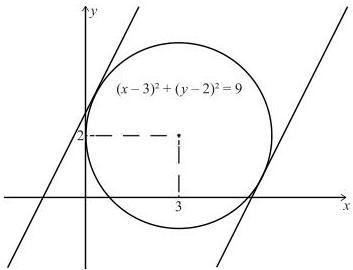
- Substitute: .
- Expand: .
- Rearrange into a quadratic in : .
- Apply : .
- Simplify: . Taking square roots gives . Solving these linear equations provides the two possible values of .
Shortest Distance Problems
Calculating the shortest distance between a circle and a line is a common coordinate geometry task. The shortest distance usually lies along the line passing through the centre of the circle that is perpendicular to the given line.
Worked Example: Closest Distance
Find the closest distance between and the circle .
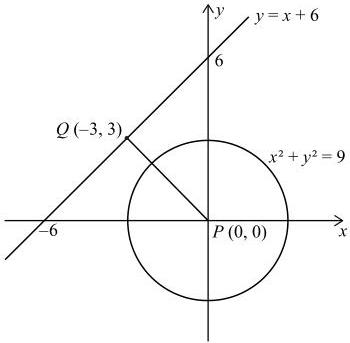
- To simplify, translate the circle to the origin by replacing with and with . The circle becomes and the line becomes .
- In this orientation, the point on the line closest to the origin is .
- The distance .
- Subtract the radius (3) from this distance to find the shortest gap: .
Key takeaways
- The standard form clearly identifies the centre and the radius .
- To convert the expanded form into standard form, you must complete the square for both the and variables.
- A circle equation is only valid if, after completing the square, the constant on the right hand side is positive.
- Interaction between a line and a circle can be solved by substitution and the discriminant. A tangent corresponds to exactly one solution where .
- The shortest distance from a point or line to a circle is found by calculating the distance to the centre and subtracting the radius.
When identifying the radius from the equation , students often forget to take the square root of . Always double check that you have .
Be careful with signs when identifying the centre. The equation has its centre at . This means has its centre at .
The relationship between a line and a circle is a geometric instance of the discriminant of a quadratic. If the quadratic formed by substitution has , the line is a secant (two intersections). If , it is a tangent. If , the line does not meet the circle.
Worked Examples
Practice Questions
Frequently asked questions
What happens if the coefficients of and are different?
If the coefficients are different, such as , the shape is not a circle. It is likely an ellipse. For a circle, the coefficients of and must be equal.
Can the radius of a circle be negative?
No. In the equation , represents a distance and must be positive. If the right hand side of the equation is negative after completing the square, the equation represents no real points.
How do I find the equation of a tangent at a specific point on the circle?
Calculate the gradient of the radius from the centre to the point . The tangent is perpendicular to this radius, so its gradient is the negative reciprocal. Then use the point gradient formula .
Does always represent a circle?
Not necessarily. It only represents a circle if . If this value is zero, it represents a single point. If it is negative, there are no real solutions.