Coordinate Geometry of Straight Lines for the TMUA
Updated September 2025
Understand the algebraic and geometric properties of straight lines in the (x,y)-plane. This section covers the different forms of linear equations, the interpretation of gradient as a rate of change, and the specific conditions required for lines to be parallel or perpendicular, all essential for the TMUA.
A straight line in the Cartesian plane is defined by a constant rate of change known as the gradient . Its position and orientation are uniquely determined by its gradient and a point it passes through, or by any two distinct points on the line.
The Gradient and Linear Equations
Every straight line can be defined by its gradient and its position on the plane. The most familiar form is , where represents the gradient and is the -intercept (the value of where the line crosses the -axis).
Interpreting the Gradient
The gradient measures the steepness of a line. If is positive, the line slopes upwards from bottom left to top right. If is negative, it slopes downwards from top left to bottom right. We can think of steepness as a rate of change: for every 1 unit move horizontally (in the direction), we must move units vertically (in the direction) to remain on the line.
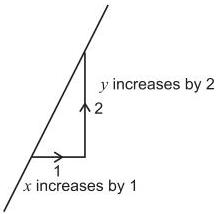
In the diagram above, the gradient is 2. For every 1 unit of increased, increases by 2.
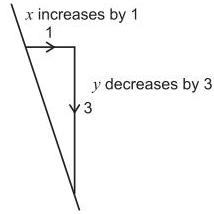
In this second diagram, the gradient is -3. For every 1 unit of increased, decreases by 3. Thus, the gradient tells us how fast changes relative to .
Trigonometric Interpretation of Gradient
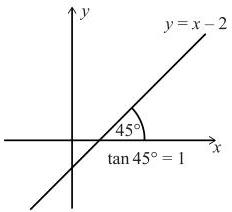
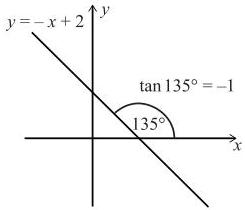
A more sophisticated way to view the gradient is as the tangent of the angle that the line makes with the positive -axis (assuming equal scales on both axes). Therefore, . For example, a line at 45 degrees has , and a line at 135 degrees has .
Special Cases: Vertical and Horizontal Lines
Horizontal lines have a gradient of zero and take the form , where is a constant. The -axis itself is the line . Vertical lines do not have a strictly defined finite gradient (often called infinite) and take the form . The -axis is the line .
Parallel and Perpendicular Lines
Two lines and are parallel if and only if they have the same steepness, meaning .
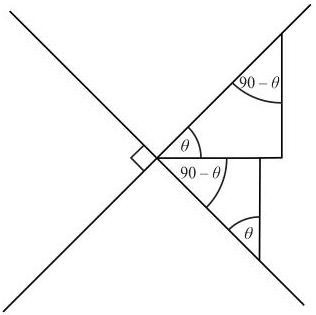
Two lines are perpendicular if and only if the product of their gradients is -1, expressed as . This condition excludes horizontal and vertical lines, which are perpendicular but have gradients of 0 and undefined respectively. You can visualize this using similar triangles:
Forms of the Equation
In the TMUA, you must be comfortable with various algebraic forms of a line.
- Point-Gradient Form: . This is particularly useful when you know the gradient and a specific point on the line.
- General Form: . In this form, , , and are constants. Note that here is NOT the -intercept. You should be able to rearrange this into to identify the gradient.
Finding Equations of Straight Lines
To uniquely specify a line, you need two pieces of information. There are two primary cases:
Case 1: One point and the gradient
Given a point and a gradient , the equation is derived from the fact that the gradient between any general point and must be :
Worked Example: Find the line with gradient through . Using :
Worked Example: Find the line with gradient through .
Case 2: Two distinct points
Given and , first calculate the gradient . Ensure the order of subtraction is consistent for both and to avoid sign errors.
Worked Example: Find the line through and . First, find : . Now use and the point :
Worked Example: Find the line through and . Since the -values are the same, the gradient is . This is a horizontal line with the equation .
Key takeaways
- The gradient is the rate of change of with respect to , which is also .
- Parallel lines have equal gradients (), while perpendicular lines satisfy .
- Use the form to quickly construct equations from a point and a gradient.
- Always be careful with sign errors when substituting negative coordinates into .
When given two points, always check if the -coordinates or -coordinates are the same first. If , the line is vertical (). If , the line is horizontal (). This saves time compared to using the gradient formula.
A common mistake is getting the gradient formula upside down. Remember (rise over run). Another trap is forgetting to multiply the entire bracket by when rearranging equations.
The gradient of a line is the simplest example of a derivative. In calculus, we find the gradient of a curve at a point by finding the gradient of the straight-line tangent at that exact location.
Frequently asked questions
What happens to the gradient of a vertical line?
A vertical line has no defined finite gradient because the change in is zero, and division by zero is undefined. We represent these lines as .
How do I find the gradient from the general form ?
Rearrange the equation into the form . This gives , so . The gradient is .
Why is the perpendicular gradient formula ?
Geometrically, if a line has a gradient , rotating it 90 degrees swaps the rise and run and negates one of them, leading to a new gradient of .
Does always mean the -intercept?
Only in the specific form . In the general form , the constant is not the -intercept; the -intercept in that case is actually .