Laws of Logarithms for University Admission
Updated August 2025
Logarithms are the inverse of exponential functions, allowing us to determine the power to which a base must be raised to produce a given value. This page covers the fundamental logarithmic laws, their graphical representations, and the necessary constraints for TMUA and ESAT preparation.
A logarithm is defined by the equivalence , representing the power needed for base to reach value .
Logarithms are very closely related to indices. In fact, they are really the inverse of indices: they tell you what power a number has to be raised to, rather than raising a number to a power. Historically, logarithms were invented to make complex calculations easier before the existence of calculators, by converting multiplication into addition.
The Fundamental Definition
The base of a logarithm, written as a subscript, identifies the number being raised to a power. For example, tells you what power 10 needs to be raised to in order to get a given number:
- because .
- because .
- because .
- because .
We can use any base . For example, tells you what power 2 needs to be raised to reach a value:
- because .
- because .
In general, the relationship is . There are three critical restrictions to remember for the TMUA: the base must be positive () and not equal to 1, the number we take the log of () must be positive (), but the resulting log () can be any real number, including zero or negative values.
Graphical Representation
We can understand logarithms by looking at them as the inverse of exponential graphs. Consider . This function takes an input from the axis and provides a value. If we start on the axis and trace back to the axis, we are finding the logarithm.
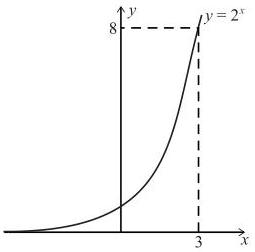
The graph of is simply the graph of with the and axes swapped. This is a reflection in the line .
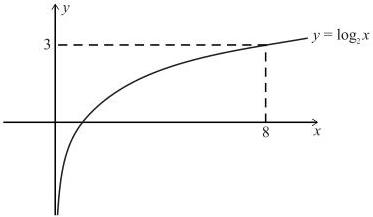
Note that the log graph is only defined for and it always crosses the axis at 1, because for any base , meaning .
The Laws of Logarithms
You must be fluent in manipulating logarithms using these four primary rules. Their derivations are rooted in the laws of indices.
1. The Product Rule: This is the logarithmic equivalent of . We can see this works because .
2. The Quotient Rule: This corresponds to the index law . Derivation: .
3. The Power Rule: This follows from . Derivation: .
4. Special Cases:
- The Reciprocal Rule: . This is a specific instance of the power rule where .
- Base Identity: , because .
Change of Base Formula
Although questions specifically requiring the change of base formula will not be set in the TMUA, it is a useful tool for your mathematical kit. It allows you to convert a logarithm from one base to another:
A useful result of this is that . You can derive this by letting , which means . Taking of both sides gives , or , leading to .
Key takeaways
- The fundamental identity is .
- Logarithms are only defined for positive arguments () and positive bases ().
- Addition of logs corresponds to multiplication of arguments: .
- Subtraction of logs corresponds to division of arguments: .
- The power rule allows coefficients to move to the exponent: .
When solving logarithmic equations in the TMUA, always check your final answers against the original constraints. If a solution results in taking the log of a negative number or zero, it must be discarded.
The most common mistake is forgetting that the argument of a log must be strictly positive. Always ensure in .
The logarithm is the only function that transforms multiplication into addition. This property makes it fundamentally important in fields ranging from complexity theory in computer science to the measurement of sound (decibels) and earthquakes (Richter scale).
Worked Examples
Practice Questions
Frequently asked questions
Can the result of a logarithm be negative?
Yes. While the base and the argument must be positive, the result can be any real number. For example, .
Why is always zero?
Because any positive base raised to the power of 0 equals 1 (), the inverse operation must yield .
Is equal to ?
No. This is a common error. The correct law is . There is no simple law for expanding the logarithm of a sum.