Trigonometric Values for Special Angles
Updated August 2025
Mastering the exact values of sine, cosine, and tangent for special angles is essential for the TMUA, as these examinations often require precise non-calculator answers. Learn to derive these values using standard triangles for , , , , and to ensure accuracy in geometric and algebraic problems.
The exact values of trigonometric functions for specific angles (, , , , and ) are derived from the geometry of the unit square and the equilateral triangle. These values allow for the calculation of lengths and angles without a calculator using ratios such as and .
In the TMUA and ESAT, you are expected to know the exact values of trigonometric functions for several key angles. While these can be memorised, it is far more reliable to understand how to derive them using two specific 'standard triangles'. You should also be able to identify these values on the graphs of , , and .
Deriving Values for
To find the trigonometric values for (or radians), we consider an isosceles right-angled triangle. If we set the two shorter sides to have a length of 1, we can use Pythagoras' theorem to find the hypotenuse: .
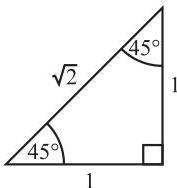
From this triangle, we can immediately read off the ratios for an angle of :
Note that is often written in its rationalised form as . Both forms are mathematically equivalent and acceptable in the exam.
Deriving Values for and
For the angles ( radians) and ( radians), we use half of an equilateral triangle. We start with an equilateral triangle where every side has a length of 2. By dropping a perpendicular line from one vertex to the opposite side, we split the triangle into two congruent right-angled triangles.
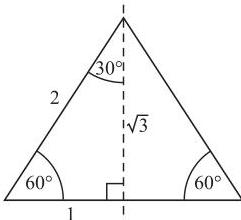
This process creates a triangle with angles of and . The base is halved to 1, the hypotenuse remains 2, and the vertical height is calculated via Pythagoras as . Using this triangle, we find:
For :
For :
- (which is also )
Values for and
The boundary values are best understood by looking at the unit circle or the trigonometric graphs. As the angle approaches , the vertical component (sine) vanishes, while the horizontal component (cosine) reaches its maximum.
- At : , , and .
- At : , . For the tangent function, we observe that , which is undefined. This corresponds to the vertical asymptote on the graph of .
Graph Identification and Extension
You should be able to locate these exact values on the standard sketches of , , and . For example, the point sits on the cosine curve, and sits on the tangent curve. Knowing these values allows you to find related angles in other quadrants, such as or , by applying the symmetries and periodicities of the functions.
Key takeaways
- The values are derived from a isosceles right-angled triangle.
- The and values are derived from an equilateral triangle of side 2 split in half to form a triangle.
- is undefined because it involves division by zero, representing a vertical asymptote on its graph.
- Values such as and show the complementary relationship between sine and cosine.
If you forget a value during the exam, quickly sketch the two standard triangles ( and ) in the margin of your paper. This is much safer than trying to recall a table from memory under pressure.
Be careful when identifying these values on a graph. A common mistake is to swap the sine and cosine values for and . Always remember that increases from to , while decreases.
Notice the symmetry: . This is why and . This relationship is fundamental to understanding how these functions work together in geometry.
Worked Examples
Practice Questions
Frequently asked questions
Why is undefined?
The tangent function is defined as . Since , calculating requires dividing by zero, which is mathematically undefined.
Do I need to know these in radians as well as degrees?
Yes. The TMUA/ESAT requires fluency in both. , , , and .
Should I use or ?
Both are correct. TMUA questions may use either form in the multiple-choice options, so you should be comfortable identifying both.