Trigonometric Functions Graphs and Symmetries for the TMUA
Updated August 2025
This guide covers the fundamental properties of sine, cosine, and tangent functions for the TMUA. You will learn to identify their periodic graphs, understand their inherent symmetries, and interpret them as projection operators. Mastering these visual and algebraic features is essential for solving complex trigonometric equations and transformations.
Trigonometric functions are periodic mappings derived from the unit circle, where and represent vertical and horizontal projections of a unit radius, and represents the ratio .
Standard Graphs and Periodicity
For the TMUA, you must be intimately familiar with the standard graphs of the sine, cosine, and tangent functions. This includes knowing their shapes, where they cross the axes, and their repetitive nature. You should be able to sketch these in both degrees and radians.
- Sine and Cosine: These functions are periodic with a period of (or radians). This means the graph repeats its entire cycle every .
- Tangent: This function is periodic with a shorter period of (or radians). Notably, is not defined, leading to vertical asymptotes at , , and every thereafter.
Modifying Trigonometric Graphs
Understanding how to modify these functions is a key skill. Consider the following exercises to test your comprehension of how coefficients affect the amplitude and period of the graph. Sketching these for ranges like to or to helps reveal their behavior:
- , (vertical stretch), and (horizontal squash).
- , , and .
- , , and .
You should also be able to sketch and on the same axes. By doing so, you can observe where they intersect: for instance, when or (within the 0 to 360 degree range), and in other specific intervals.
Advanced transformations like require careful attention to the order of operations. This specific example involves a horizontal squash by a factor of 2 and a translation by to the left, which is equivalent to .
Sine and Cosine as Projection Operators
A powerful way to interpret trigonometric functions is as projection operators. They project a line of a specific length, originating from the center at an angle , onto the or axes. In this context, the line always has a positive length.
- The cosine function projects the line onto the -axis.
- The sine function projects the line onto the -axis.
This interpretation helps clarify why these functions change sign in different quadrants, as seen in traditional CAST diagrams.
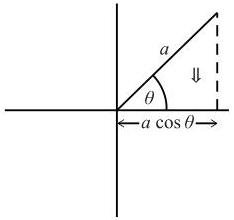
In the diagram above, the projection onto the -axis () is positive because the line is in the first quadrant.
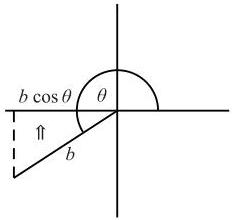
In the second quadrant, the projection is negative because it falls on the negative -axis.
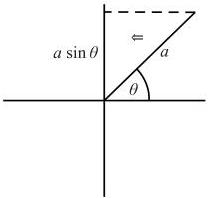
Similarly, for sine, the projection onto the -axis is positive when the line points upwards in the first or second quadrants.
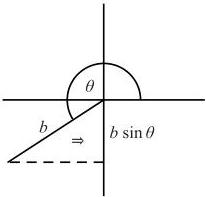
In the fourth quadrant, the projection is negative as it falls below the -axis.
The Tangent Function Interpretation
The tangent function converts -axis projections into -axis projections. Mathematically, it is the ratio of the -projection to the -projection.
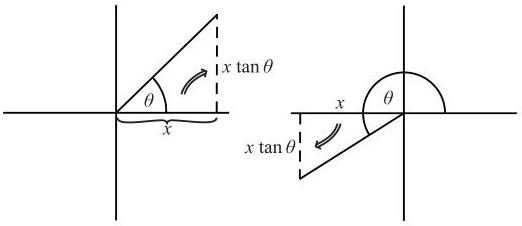
Consider the signs in different quadrants. Between and (the second quadrant), is negative and is positive, making negative. Between and (the fourth quadrant), is positive and is negative, so is again negative.
Key takeaways
- The sine and cosine functions have a period of ( rad), while tangent has a period of ( rad).
- is an odd function (reflection in origin), while is an even function (reflection in -axis).
- Tangent is undefined at because the horizontal projection (-axis) is zero at these points.
- Graph transformations like must be handled by factoring out to correctly identify the horizontal translation.
When solving trig equations, always sketch the graph or use a CAST diagram to find all possible solutions within the given range. Many students forget the second set of solutions provided by the graph's symmetry.
Be careful with horizontal translations. In the expression , the shift is not to the left. You must factor it as , showing the actual translation is to the left.
The symmetry of trigonometric graphs allows us to derive many identities. For example, the fact that is a horizontal shift of is why .
Worked Examples
Practice Questions
Frequently asked questions
What does it mean for a function to be periodic?
A function is periodic if its values repeat at regular intervals. For sine and cosine, the interval is , meaning for any integer .
Why is the graph of tangent different from sine and cosine?
Because , the graph has vertical asymptotes whenever . These occur at , etc., where the function shoots off to infinity.
How can I remember which quadrants have positive or negative trig values?
Use a CAST diagram or think of the projection. Cosine is positive where the -axis is positive (right side); Sine is positive where the -axis is positive (top side).