Solving Trigonometric Equations for the TMUA
Updated August 2025
Master the techniques for solving trigonometric equations within specific intervals for the TMUA. This page covers using principal values to find multiple solutions, handling compound angles correctly, and solving quadratic equations involving trigonometric identities such as .
Trigonometric equations are solved by finding a principal solution using an inverse function and then applying the periodic and symmetrical properties of the graph (or a CAST diagram) to locate all other solutions within the required interval.
Solving trigonometric equations requires a systematic approach to ensure no solutions are missed within the specified range. The TMUA expects you to be comfortable using both graphical and CAST type methods to list the full set of solutions for a given interval.
The Order of Operations in Solving Equations
When solving equations of the form , it is critical to find the full set of solutions for the compound angle before performing any algebraic rearrangement to find . A common error is to rearrange the basic solution first and then attempt to find other values, which frequently leads to missing solutions.
Worked Example: Handling Compound Angles
Question: Solve for
Step 1: Take the square root. We must consider both the positive and negative square roots. This gives us two equations to solve: and
Step 2: Find the basic solution. For , the basic solution (the one a calculator gives) is .
Step 3: List solutions for the compound angle. Because we will eventually divide by 2 and subtract 60 to find , we must look at a range for that extends beyond the target range of . We list all relevant solutions for based on the symmetry of the sine graph:
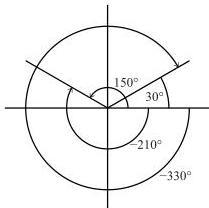
From the symmetry of the graph (or CAST diagram), we find:
Step 4: Solve for x. Now we subtract 60 from each and divide by 2:
Step 5: Filter by the interval. We select only those values in the range :
Avoiding the Rearrangement Error
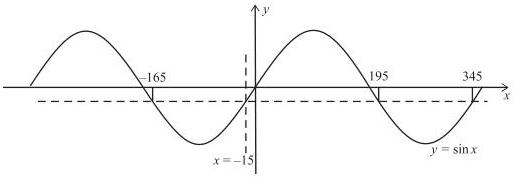
If you rearrange the basic solution before finding the general solutions, you will lose roots. For example, starting with and rearranging to , then trying to find other values by adding periods of the sine graph, results in a significantly reduced set of solutions (). The following diagram illustrates why this method is incorrect:
Using Trigonometric Identities to Solve Quadratics
Trigonometry is often mixed with quadratics. To solve these, you must use identities to ensure the entire equation is in terms of a single trigonometric function, such as or .
Identity 1: Identity 2:
Worked Example: Quadratic Trig Equation
Question: Solve for .
Step 1: Use the Pythagorean identity. Since the equation has a term, we convert the term using :
Step 2: Simplify to a standard quadratic. Let to make the algebra clearer:
Step 3: Factorise and solve for S: This gives or .
Step 4: Solve for x: If , then (within the open interval ). If , then or .
Final solutions: .
Key takeaways
- Always consider both the positive and negative square roots () when solving an equation involving squared trigonometric functions.
- For compound angles like , find all possible values for the entire bracket before rearranging for .
- The identity is essential for converting equations into a single trigonometric function, allowing them to be solved as quadratics.
- Be precise with the interval: check whether the boundaries are included () or excluded ().
When solving , remember that the tangent function has a period of ( radians) and no symmetry within that period like sine or cosine. You can simply find the principal value and add or subtract multiples of () to find all other solutions.
Do not divide both sides of an equation by a trigonometric function like , as you may lose valid solutions where . Instead, factorise the expression.
The relationship between roots and factors remains true for trigonometry. If is a solution, then is a factor of the trigonometric expression. This is why we treat trig quadratics just like algebraic ones.
Worked Examples
Practice Questions
Frequently asked questions
How do I know if I have found all the solutions in the interval?
Use the periodic nature of the function. For and , the period is ( radians). For , it is ( radians). Always sketch the graph or use a CAST diagram to check for reflections (e.g., for sine) within the expanded range of a compound angle.
Should I use the graph method or the CAST diagram?
Both are valid and should yield the same results. The graph method is often more intuitive for visualizing the total number of solutions, while the CAST diagram is very efficient for finding the related angles in different quadrants. The TMUA guide recommends being comfortable with both.
Why does work for any angle?
This identity is a direct consequence of Pythagoras' Theorem applied to a right-angled triangle with a hypotenuse of 1. It holds for all real angles, as shown by the unit circle definition of sine and cosine.